
Introduction
For furniture wholesalers importing upholstered sofas into the United States, flammability compliance is a purchasing requirement that cannot be left until the shipment reaches the destination port.
California Technical Bulletin 117-2013 is one of the most frequently misunderstood regulations in international sofa manufacturing. Some overseas factories still associate it with the older TB 117 requirements, while others assume that testing an upholstery fabric alone is enough to establish compliance for the finished product.
Both assumptions can create problems.
An imported sofa may contain a compliant cover fabric but use filling materials that have not been properly evaluated. A factory may also have a valid material test report but fail to install the required barrier construction or attach the correct permanent compliance label.
For wholesalers and importers, these mistakes can lead to additional inspections, delayed distribution, rejected project deliveries, corrective production work, and potential enforcement action.
The situation is particularly important because California's TB 117-2013 is now incorporated into federal upholstered furniture flammability requirements under 16 CFR Part 1640. The requirements are therefore relevant to applicable upholstered furniture manufactured or imported for the US market, not simply products sold in California.
This guide explains California TB 117-2013 upholstered furniture flammability requirements from a practical sourcing perspective. It covers the materials that need attention, common factory documentation mistakes, permanent labeling, and the checks buyers should complete before authorizing bulk production.
The objective is to help furniture importers establish a reliable compliance process between overseas manufacturers, testing laboratories, purchasing teams, and US distribution channels.
1. Core Requirements of California TB 117-2013 for Upholstered Sofas
Understanding the relationship between California and federal regulations
California introduced TB 117-2013 to evaluate the smolder resistance of materials used in upholstered furniture.
The official title is:
Requirements, Test Procedure and Apparatus for Testing the Smolder Resistance of Materials Used in Upholstered Furniture.
The revised standard moved away from the previous TB 117 approach, which included open-flame testing of resilient filling materials.
Instead, TB 117-2013 focuses on resistance to smoldering ignition under specified test conditions.
This distinction matters when discussing California TB117 vs federal flammability rules for upholstery.
The federal government subsequently incorporated TB 117-2013 into 16 CFR Part 1640 through the COVID-19 Regulatory Relief and Work From Home Safety Act.
The effective dates are important for importers:
|
Requirement |
Effective date |
Procurement implication |
|
Federal upholstered furniture flammability standard, 16 CFR Part 1640 |
June 25, 2021 |
Applicable furniture manufactured, imported, or reupholstered from this date must comply |
|
Federal permanent certification labeling |
June 25, 2022 |
Applicable furniture must carry the required permanent CPSC flammability statement |
|
California TB 117-2013 |
January 1, 2014, with full implementation January 1, 2015 |
California upholstered furniture compliance requirements apply according to the relevant state provisions |
The federal rule adopts the June 2013 version of TB 117-2013. A January 2019 publication with an updated bureau name is otherwise identical. A subsequent California revision does not automatically amend the federal standard.
For buyers, this means that a supplier cannot simply argue that TB 117-2013 is unnecessary because the shipment is going to another US state.
The federal requirement must be considered independently of the furniture's final destination.
The four material categories covered by TB 117-2013
The standard establishes four test methods for materials used in upholstered furniture.
Each category addresses a different part of the upholstery construction.
1. Cover fabric – Section 1
The cover fabric is the outermost upholstery material.
It may include:
Polyester upholstery fabric
Linen-blend upholstery
Cotton fabric
Microfiber
Leather
Vinyl
Other woven, knitted, or nonwoven covering materials
The purpose of the test is to evaluate the material's resistance to smoldering under the prescribed conditions.
A common misconception among overseas suppliers is that leather or vinyl automatically qualifies without evaluation.
However, leather and other upholstery cover materials are not generally exempt from Section 1 simply because they have different surface characteristics from woven textiles.
2. Barrier material – Section 2
A barrier is an intermediate material placed between the cover material and the filling components.
Its function is to prevent a smoldering front from advancing into the filling material.
Typical barrier constructions may use specially selected nonwoven materials or other suitable interliner materials.
However, a material cannot be treated as compliant simply because it is marketed as fire-resistant or described as a protective layer.
It must meet the applicable Section 2 requirements.
Where a barrier is used to compensate for non-passing cover fabric or filling materials, the construction and coverage must meet the applicable requirements. In particular, the filling generally needs to be fully encased, subject to the specified exceptions.
3. Resilient filling material – Section 3
This category includes the materials inside upholstered seating that provide cushioning and support.
Common examples include:
Polyurethane foam
High-resilience foam
Latex foam
Other resilient filling materials
Multiple foam layers used in seat and back cushions
All applicable resilient filling materials must be considered.
A factory should not test only the main seat foam while overlooking additional foam layers, arm padding, or other filling materials used in the finished product.
If a filling material does not pass the applicable test, a compliant barrier construction may be used where the standard permits.
4. Decking material – Section 4
Decking is the material located beneath the seat cushion and above the supporting structure.
It may be made from fabric or another suitable upholstery material.
Although it is often overlooked during purchasing, decking must be evaluated when present under the applicable test provisions.
A factory that changes its decking fabric during production should therefore review whether the change affects the approved compliance evidence.
How the different components work together
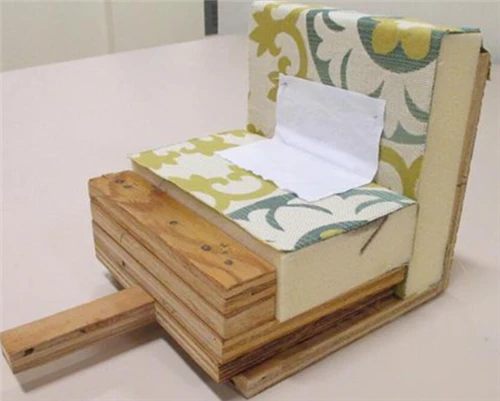
TB 117-2013 is not simply a collection of unrelated material certificates.
Its test methods use specified specimen constructions and standard materials to evaluate the relevant upholstery components.
The CPSC recognizes compliant furniture constructions using either:
A passing barrier material that completely surrounds the filling material; or
A passing cover fabric together with passing filling material.
If decking material is present, it must also pass the applicable decking test.
This creates several possible construction approaches.
|
Component test scope |
Acceptable test evidence |
Common factory errors |
|
Section 1: Cover fabric |
Applicable passing test evidence for the upholstery cover material |
Testing a similar fabric color or composition instead of the actual material |
|
Section 2: Barrier material |
Passing Section 2 evidence for the barrier used in the construction |
Using an untested interliner or changing its thickness and composition |
|
Section 3: Resilient filling |
Passing Section 3 evidence for applicable filling materials |
Testing only one foam grade while using several grades in production |
|
Section 4: Decking material |
Passing Section 4 evidence where decking is present |
Ignoring the underside seat material or changing it without review |
The key procurement issue is traceability.
The buyer needs to know which fabric, foam, barrier, and decking materials were evaluated and whether those materials correspond to the approved production specification.
Why the test is not the same as an open-flame furniture test
Some suppliers still describe TB 117-2013 as a general fire-resistance or fireproofing certificate.
That terminology is misleading.
The standard evaluates smolder resistance. It does not establish that a sofa is fireproof or that it will resist every possible ignition source.
It also does not replace other applicable fire-safety requirements for different products.
For example, a sofa bed with a detachable mattress may involve two different regulatory considerations:
The upholstered sofa portion may be subject to 16 CFR Part 1640.
The detached mattress may be subject to the federal mattress flammability standards in 16 CFR Parts 1632 and 1633.
Importers should review the product's actual construction and configuration before determining which requirements apply.

Figure 1 - Upholstered sofa component breakdown
2. Factory Missteps That Lead to TB 117 Non-Compliance
A factory may have years of experience exporting upholstered furniture and still make mistakes when preparing US compliance documentation.
The main problem is often not a complete absence of testing. It is the failure to connect the test evidence with the actual materials and construction used in mass production.
For wholesalers, the following issues deserve particular attention.
Mistake 1: Treating fabric approval as complete sofa compliance
A supplier may provide a passing test report for a particular upholstery fabric and claim that the sofa is therefore compliant.
This is incomplete.
The cover fabric is only one part of the upholstery system.
The foam, barrier, and decking materials must also be addressed according to the applicable construction requirements.
Consider a three-seat hotel lobby sofa using:
Polyester upholstery fabric
Two foam grades
Polyester fiber batting
A separate decking fabric
A passing fabric report does not automatically establish that the two foam grades and decking construction satisfy the standard.
The factory needs a material-level compliance matrix showing the relevant evidence for each component.
Mistake 2: Using a generic report for different materials
Overseas factories sometimes maintain one set of test reports for an entire fabric collection.
This can create problems when the report covers a material with a different composition, weight, coating, or backing from the one used in the purchase order.
For example, two polyester fabrics may look identical but have different:
Fiber compositions
Surface coatings
Backing materials
Fabric weights
Dyeing and finishing treatments
These differences may affect test performance.
The same concern applies to foam.
A factory should not assume that one passing report covers every foam grade used in a sofa collection.
Buyers should request the material manufacturer's identification, specification, batch information where available, and the relevant test evidence.
Mistake 3: Installing a barrier incorrectly
Barrier materials are sometimes used as a solution when the cover fabric or filling material does not pass its applicable test.
However, simply adding a thin layer of nonwoven fabric does not establish compliance.
The barrier must pass Section 2 and be installed according to the applicable construction requirements.
Common mistakes include:
Covering only the top surface of the foam
Leaving exposed foam edges
Using an untested replacement material
Installing the barrier in the wrong position
Omitting barrier material from armrests or other relevant areas
Changing the barrier thickness without reviewing its performance
The required coverage depends on the upholstery construction and the relevant exceptions in TB 117-2013.
For example, certain non-reversible and non-detachable seating cushions have specific provisions. Factories should not apply a general construction shortcut to every sofa design.
Mistake 4: Changing foam or fabric after testing
This is a frequent problem in bulk manufacturing.
A sofa may be approved using a specific foam specification and fabric reference. During production, the factory may substitute materials because of purchasing costs, supply shortages, or production scheduling.
Even when the replacement looks similar, its flammability performance may differ.
Changes requiring technical review include:
Foam density or formulation changes
Foam supplier changes
Upholstery fabric composition changes
Back-coating modifications
Barrier supplier changes
Decking material substitutions
Changes in upholstery construction
A material change should trigger a review of the existing test evidence.
The factory should document the decision rather than assuming that a previous passing result remains applicable.
Mistake 5: Confusing California labels with federal labels
This is one of the most important administrative mistakes.
California has specific upholstered furniture labeling requirements, including disclosures relating to flame-retardant chemicals under SB 1019.
Separately, federal 16 CFR § 1640.4 requires a permanent certification statement on applicable upholstered furniture.
The required federal wording is:
"Complies with U.S. CPSC requirements for upholstered furniture flammability."
A factory that prints only an older California TB 117-2013 label may fail to include the separate federal statement.
The federal statement can be incorporated into an existing label where permitted, but it must meet the federal requirements.
CPSC guidance recommends that the wording be:
Conspicuous and legible
At least 1/8 inch high
No smaller than other text on the label
Printed in black on a white background surrounded by a black border
The statement must appear on the front of the label in English.
Additional languages may appear on the reverse side.
A hangtag, zip tie, or removable packaging sticker does not qualify as a permanent label.
Mistake 6: Assuming a GCC is mandatory for TB 117-2013
Some suppliers prepare a General Certificate of Conformity (GCC) because they believe every US product regulation requires one.
However, CPSC specifically explains that a GCC is not required to demonstrate compliance with 16 CFR Part 1640.
The permanent certification label is the required certification mechanism under this rule.
This does not mean importers should ignore documentation.
Maintaining test reports, supplier declarations, material specifications, and production records remains a valuable procurement practice.
It also does not eliminate any separate certification obligations arising from other applicable CPSC requirements.
Mistake 7: Overlooking importer responsibilities
A foreign manufacturer cannot assume that every compliance responsibility ends when the container leaves its factory.
California BHGS guidance explains that responsibility under California law rests not only with manufacturers but also with importers, wholesalers, retailers, and other parties possessing furniture for sale.
For a US importer, this means supplier documentation should be reviewed before the order is released for production.
The importer should also establish a contractual process for handling material substitutions, labeling errors, and non-compliant deliveries.
For hospitality projects, the consequences can extend beyond a single shipment.
A non-compliant product may prevent project handover, delay room installation, or require expensive replacement work. Figure 2 - Permanent sofa compliance label
3. Pre-Shipment Verification Process for Flammability Compliance
For wholesalers importing upholstered sofas in bulk, the most effective approach is to build flammability verification into the production approval process.
Waiting until the goods are packed or shipped creates unnecessary commercial risk.
A structured verification procedure should connect the product specification, material test evidence, factory production records, and permanent labels.
Step 1: Identify the applicable regulatory requirements
Begin by identifying the product category and destination market.
For ordinary indoor upholstered sofas, the buyer should review:
16 CFR Part 1640
California TB 117-2013
Applicable California labeling provisions
Project-specific fire-safety requirements
Other applicable material and chemical regulations
The product definition matters.
Under 16 CFR § 1640.3, upholstered furniture generally includes indoor seating furniture with an upholstered seat, back, or arm and the relevant filling or cushioning construction.
Mattresses and certain other products are excluded from this definition or regulated separately.
For hospitality projects, confirm whether the order includes:
Standard upholstered sofas
Lounge chairs
Sofa beds
Detachable mattresses
Loose seating cushions
Decorative pillows
Different product categories may require different compliance assessments.
Step 2: Request a complete material compliance package
Do not accept a single cover-fabric report as the entire compliance file.
Ask the factory to prepare a material compliance schedule for every sofa model.
A practical document package includes:
|
Required document |
Information to verify |
Procurement purpose |
|
Cover fabric test report |
Fabric identity and applicable Section 1 results |
Verify outer upholstery material |
|
Barrier test report |
Barrier identity and Section 2 results |
Verify alternative protective construction |
|
Foam test report |
Foam grade and applicable Section 3 results |
Verify filling materials |
|
Decking test evidence |
Material identity and Section 4 results where applicable |
Verify underside seating construction |
|
Material specification |
Composition, supplier, product reference |
Match test evidence with production |
|
Approved BOM |
Material references for each sofa model |
Establish traceability |
|
Permanent label artwork |
Exact federal statement and label layout |
Check labeling before mass production |
|
Production photographs |
Actual materials and construction |
Confirm implementation |
When reviewing documents, check that the tested material corresponds to the actual supplier and material specification.
A report for a similar product should not automatically be accepted as evidence for a different material.
Step 3: Verify the laboratory and testing records
Importers should review the source and completeness of the test documentation.
Check the following information:
Laboratory name and address.
Unique report number.
Test date.
Material description.
Applicable TB 117-2013 section.
Test method and specimen details.
Individual results and final determination.
Laboratory authorization and report status.
Where the laboratory claims ISO/IEC 17025 accreditation, verify that the relevant test method is included in its accreditation scope.
It is also important to distinguish between a laboratory report and a supplier declaration.
A supplier declaration may be useful for traceability, but it should not be presented as an independent laboratory result.
CPSC does not maintain a general list of pre-approved fabrics or foams. Buyers should therefore evaluate the actual supporting evidence rather than relying on a supplier's marketing statement.
Step 4: Match the reports with the final production BOM
The bill of materials is an important control document for upholstered furniture.
It connects the tested materials with the product that the factory will actually manufacture.
For example, a hotel sofa BOM may identify:
Outer fabric: polyester upholstery, supplier reference F-203
Seat foam: high-resilience polyurethane foam, grade HR35
Back foam: polyurethane foam, grade D28
Barrier: nonwoven interliner, reference B-12
Decking: polyester fabric, reference D-08
These references should match the corresponding test records and approved construction.
If the factory changes any of these materials, the purchasing team should require a compliance review before production continues.
This is particularly important for OEM and ODM orders where several product models may share a common upholstery collection but use different internal constructions.
Step 5: Approve the permanent compliance label
The federal label should be reviewed before bulk production, not after the sofas have been upholstered and packed.
The exact required statement is:
Complies with U.S. CPSC requirements for upholstered furniture flammability.
Check that:
The wording is reproduced accurately.
The label is permanently attached to the product.
The statement appears on the front.
The English wording is included.
The text is sufficiently large and legible.
The label is not replaced by a hangtag or removable sticker.
For California-bound furniture, the buyer should also review the applicable state disclosure requirements.
In particular, California SB 1019 addresses disclosure of flame-retardant chemicals in upholstered furniture and requires appropriate labeling where applicable.
The California disclosure label and the federal flammability certification statement serve different purposes.
One does not automatically replace the other.
Step 6: Inspect the actual production construction
A document review should be supported by a physical production inspection.
Ask the factory QC team to inspect representative samples before upholstery materials conceal the internal construction.
The inspection should verify:
Correct foam grades
Correct barrier materials
Proper barrier placement
Filling coverage
Correct fabric references
Correct decking material
Consistency with the approved BOM
For bulk sofa orders, it is useful to photograph the internal structure of representative units and maintain the images in the production quality file.
This creates evidence that the factory followed the approved construction.
Step 7: Conduct pre-shipment document verification
Before shipment release, the importer or appointed third-party inspector should compare the production records with the approved compliance package.
A practical final checklist is shown below.
|
Verification item |
Pass condition |
Action if discrepancies are found |
|
Model identification |
Matches approved purchase specification |
Hold approval until corrected |
|
Cover fabric |
Matches tested material reference |
Request updated evidence or technical assessment |
|
Foam materials |
All relevant filling materials are identified |
Review missing material evidence |
|
Barrier construction |
Matches approved passing barrier specification |
Inspect and correct construction |
|
Decking |
Correct material and applicable test evidence |
Obtain supporting evidence |
|
Label wording |
Exact federal statement is present |
Correct label artwork |
|
Label attachment |
Permanently secured to furniture |
Replace removable or missing labels |
|
California disclosure |
Applicable state requirements addressed |
Correct disclosure label |
|
BOM consistency |
Matches approved production materials |
Investigate substitutions |
|
Production records |
Complete and traceable |
Obtain missing records |
A visual inspection alone cannot prove flammability performance.
However, it can identify incorrect materials, missing labels, and obvious differences between the approved construction and the finished products.
The test evidence and the physical inspection should work together.
Step 8: Maintain compliance records throughout production
CPSC guidance identifies the permanent label as the required certification mechanism under Part 1640 and recommends maintaining compliance records at least for as long as the product remains in production.
For wholesalers, a more comprehensive internal record system is advisable.
Maintain:
Laboratory reports
Material specifications
Supplier identification
Approved BOMs
Product drawings
Label artwork
Material substitution approvals
Production inspection photographs
Pre-shipment inspection records
Purchase orders and shipment identification
These documents can help resolve questions raised by distributors, hotel operators, project consultants, and regulatory authorities.
Hospitality projects require additional coordination
The risks are particularly relevant to hotel, resort, and multifamily furniture procurement.
A hospitality project may involve several hundred upholstered seating units distributed across guestrooms, reception areas, shared lounges, and amenity spaces.
Although the products may look similar, their internal construction and upholstery specifications can differ.
For example, a hotel may approve a polyester fabric for guestrooms but specify a coated upholstery material for high-traffic public areas.
The supplier must ensure that the relevant material evidence covers the actual materials used in each product configuration.
This is why hospitality sofa flammability compliance for California projects should be addressed during the technical submittal stage rather than left to the final inspection.
A project compliance file should identify each sofa model, upholstery reference, filling construction, applicable test evidence, and label requirement.
For fabric flammability testing for bulk sofa orders to US, buyers should also pay attention to consistency between production batches.
A replacement fabric with the same commercial name may have a different backing or finish. A foam supplier may also change its formulation without changing the general product description.
Any material substitution should therefore be reviewed before it enters production.
Figure 3 - Bulk commercial sofa shipment

Final recommendations for US furniture wholesalers
California TB 117-2013 upholstered furniture flammability should be treated as a product-level procurement responsibility rather than a document collection exercise.
The most reliable sourcing process begins with identifying the correct regulatory requirements and continues through material approval, BOM verification, production inspection, and permanent labeling.
Before authorizing a container shipment, confirm these five essentials:
The sofa falls within the applicable upholstered furniture requirements.
The cover fabric, filling materials, barrier, and decking have been addressed according to the actual construction.
The supporting test evidence matches the production materials.
The required federal permanent label is correctly attached.
Applicable California chemical disclosure and project-specific requirements have been reviewed.
Importers should also remember that TB 117-2013 is a smolder-resistance standard, not a guarantee that a sofa is fireproof or compliant with every possible fire-safety requirement.
A factory that can provide traceable material evidence, control production substitutions, and apply the correct labeling is better equipped to support repeat wholesale orders.
For commercial furniture buyers, compliance should be established before production begins. Correcting a material or labeling problem before container loading is generally far less disruptive than addressing it after the shipment reaches the US distribution network.
Sources and Further Reading
1. California Technical Bulletin 117-2013
Bureau of Household Goods and Services (BHGS), California Department of Consumer Affairs.
Official publications and technical bulletin resources: https://bhgs.dca.ca.gov/forms_pubs/index.shtml
2. CPSC Upholstered Furniture Flammability Guidance
US Consumer Product Safety Commission. Official guidance covering 16 CFR Part 1640, component testing, permanent labels, and importer questions.
https://www.cpsc.gov/FAQ/Upholstered-Furniture
3. California TB 117-2013 Frequently Asked Questions
California Bureau of Household Goods and Services. Includes technical explanations of barrier construction, filling materials, fabric testing, and labeling.
https://bhgs.dca.ca.gov/forms_pubs/tb117-2013_faq_0619.pdf
4. 16 CFR Part 1640 – Standard for the Flammability of Upholstered Furniture
US federal regulation covering upholstered furniture flammability requirements, certification labeling, and incorporation of TB 117-2013.
https://www.ecfr.gov/current/title-16/chapter-II/subchapter-D/part-1640
5. California SB 1019 – Flame Retardant Chemical Disclosure
California Legislative Information. Requirements concerning disclosure of flame-retardant chemicals in upholstered furniture.
https://leginfo.legislature.ca.gov/