
Patent Announcement
Huizhou Lanmasen Technology Co., Ltd. (brand: JSC) announces that the China National Intellectual Property Administration (CNIPA) has granted Utility Model Patent No. ZL 2024 2 2416016.2 for "a quick assembly and disassembly structure for modular sofas" . The patent was filed on October 8, 2024, and granted on August 15, 2025, with Publication No. CN 223220201 U. The inventor is Xie Yunzhi, and the patent holder is Huizhou Lanmasen Technology Co., Ltd. [NOTE: The patent details above are transcribed from the CNIPA utility model certificate. Current legal status, annuity payments, and any assignment records should be verified via the CNIPA patent register or directly with the manufacturer.]
Modular sofas - seating systems composed of independent sections that connect to form L-shapes, U-shapes, or custom configurations - have grown rapidly in both residential and contract markets. The ability to reconfigure, replace, or expand a seating system without buying an entirely new sofa is compelling. But modularity creates a logistics challenge: how to ship, store, and assemble multiple sections quickly, reliably, and without tools.
The Logistics Problem with Traditional Modular Sofas
A conventional modular sofa ships as several large, heavy cartons, each containing a fully upholstered section. The sections connect at the job site using metal brackets, hooks, or bolts. The assembly process typically requires two people, a set of tools, and 30 to 60 minutes of work. Misaligned brackets, missing hardware, and damaged connectors are common sources of installation delays and customer dissatisfaction.
For B2B buyers - furniture retailers, e-commerce fulfillment operations, hospitality procurement teams, and contract furniture dealers - the logistics cost of modular sofas extends far beyond the factory gate. Key pain points include:
• Freight density: Fully upholstered sections are bulky and light relative to their volume, so they cube out trailers before weighing out. This means shippers pay for air.
• Damage rates: Large upholstered sections are vulnerable to crushing, abrasion, and moisture damage during transit. A damaged corner can render an entire section unsellable.
• Last-mile delivery: A fully assembled sofa section may not fit through standard doorways, stairwells, or elevators, requiring white-glove delivery at premium cost.
• Returns and exchanges: If a customer wants to reconfigure or add a section, the logistics process repeats from scratch.
• Warehouse space: Storing large, pre-assembled sections consumes expensive warehouse cube space.
A quick-assembly modular structure addresses all of these pain points by allowing the sofa to ship in flat, compact components that are assembled on-site without tools.
How Quick-Assembly Modular Structures Work
[NOTE: The following technical interpretation is based on the patent title and publicly known engineering principles for modular sofa connector systems. It does not reproduce the patent's claims. For the exact structural scope, refer to the full CNIPA publication.]
Quick-assembly modular sofa structures generally use one or more of the following connector technologies:
Snap-fit connectors use spring-loaded tabs or clips that engage when two sections are pushed together. The user aligns the sections and applies firm pressure; the connector clicks into place and holds the sections together. To disconnect, the user releases a tab or lever. Snap-fit connectors are fast and tool-free but can be difficult to align if the sections are heavy, and they may develop play over time if the spring fatigues.
Hook-and-eye connectors use a metal hook on one section that drops into a slot or eye on the adjacent section. Gravity holds the hook in place. This design is simple, strong, and durable, but it requires the user to lift one section and lower it onto the other - a two-person operation for heavy sections.
Cam-lock connectors use a rotating cam that draws two sections together and locks them. The user inserts a bolt or pin into a pre-drilled hole, then turns the cam with an Allen key or a hand lever. Cam locks provide strong, rattle-free joints but require a tool (unless the cam is designed for hand operation) and are slower than snap-fit or hook systems.
Magnetic connectors use powerful neodymium magnets to align and hold sections together. They are elegant and easy to use, but the holding force may be insufficient for heavy-use applications, and the magnets can be expensive.
A well-designed quick-assembly structure - such as the one covered by JSC's patent - typically combines multiple connector types to balance speed, strength, and ease of use. For example, a hook-and-eye for primary alignment and load bearing, plus a snap-fit secondary lock to prevent accidental separation. The key engineering challenge is ensuring that the connectors are self-aligning - that is, the user does not need to see or precisely position the connector to engage it.
Engineering Design Priorities
A quick-assembly mechanism that works in a showroom may fail in a real warehouse or living room. The design must account for the following priorities:
Self-alignment: The connectors should guide themselves into position as the sections are brought together. Tapered lead-ins, funnel-shaped openings, and visual alignment marks all help. A connector that requires the user to look underneath the sofa to align a bolt will be abandoned in favor of a simpler system.
Tool-free operation: The entire assembly should be completable by one person without any tools. This means hand-operated cams, snap-fits, or gravity locks - no Allen keys, screwdrivers, or wrenches.
Positive feedback: The user should receive clear tactile and audible feedback when a connection is secure - a firm click, a visible green indicator, or a resistance change. Without feedback, users may under-tighten or over-tighten, leading to loose joints or damaged connectors.
Mistake-proofing: The connectors should be designed so that they cannot be assembled incorrectly. Asymmetric shapes, keyed connectors, and color-coding prevent the user from connecting the wrong sections or connecting them in the wrong orientation.
Load capacity: Once assembled, the joint must be as strong as a conventionally bolted joint. The connectors must resist shear (side-to-side forces), tension (pulling apart), and moment (tipping or racking). For a modular sofa, the most critical load is the shear force that occurs when a user sits on the edge of one section, creating a torque that tries to separate the sections.
Durability: The connectors must survive thousands of assembly and disassembly cycles without wear or fatigue. In contract applications, a sofa may be reconfigured monthly; in residential, it may be disassembled only once for a move. The design should be rated for the expected cycle count.
The Economics of Flat-Pack Modular Sofas
The financial case for quick-assembly modular sofas is compelling. By shipping components flat rather than as fully upholstered sections, a manufacturer can typically reduce shipping volume by 40 to 60 percent. This directly reduces freight cost per unit, increases container utilization, and lowers the carbon footprint of each shipment.
Damage rates also fall. Flat components stack neatly on pallets, reducing the shifting and abrasion that damage upholstered sections. Corrugated packaging can be designed with precise fits and corner protection that is impractical for bulky, irregularly shaped upholstered sections.
Last-mile delivery becomes feasible with standard parcel carriers rather than white-glove furniture delivery services. A flat-pack modular sofa can ship via UPS, FedEx, or DHL to a residential address, dramatically reducing delivery cost and expanding the addressable market for e-commerce furniture retailers.
Warehouse efficiency improves because flat packs stack to ceiling height, maximizing cube utilization. Returns and exchanges are simpler because individual components can be shipped rather than entire sections.
For contract buyers - hotels, offices, student housing - the quick-assembly design means installations can be completed by in-house maintenance staff rather than requiring specialized furniture installers. This reduces installation cost and scheduling complexity, particularly for remote or multi-site rollouts.
Quality Control and Testing
A quick-assembly mechanism is only as good as its validation. B2B buyers should ask suppliers for the following test data:
• Assembly cycle test: The mechanism should be assembled and disassembled for the rated number of cycles (typically 500 to 5,000, depending on the application) without functional failure or excessive play.
• Static load test: The assembled joint should withstand the rated static load - typically 1.5 to 2 times the expected maximum occupant load - without permanent deformation.
• Dynamic load test: The joint should survive repeated impact loads, such as a user dropping onto the edge of the sofa, without separating or deforming.
• Environmental test: The connectors should function after exposure to temperature and humidity extremes, particularly if the product will be shipped or stored in non-climate-controlled facilities.
• Vibration test: Simulated truck vibration can reveal loose fasteners or resonant wear in the connector.
JSC sources mechanism and structural components from suppliers whose products have undergone third-party verification. For example, SGS report No. AJHL2112004546FT documents a 360-pound, 25,000-cycle fatigue test on a multi-function sofa extension mechanism, confirming no structural damage, noise, or functional loss. [NOTE: The SGS test referenced was commissioned by the component supplier, REMACRO Machinery & Technology (Wujiang) Co., Ltd., and covers the supplier's mechanism models. It is cited as supplier-level component verification, not as a test of JSC's quick-assembly modular structure specifically.]
Applications and Market Segments
Quick-assembly modular sofas serve several high-growth segments:
E-commerce furniture: Online furniture retailers need products that ship via parcel carrier, survive transit, and assemble easily by the customer. Quick-assembly modularity is a prerequisite for this channel.
Urban residential: Small-apartment dwellers value the ability to reconfigure their sofa for different occasions - movie night, dinner parties, overnight guests - and to move it through narrow doorways and stairwells.
Hospitality: Hotels and resorts use modular seating in lobbies, suites, and conference areas. Quick assembly allows properties to reconfigure spaces for different events and to replace damaged sections without taking the entire seating group out of service.
Office and coworking: Modular seating in breakrooms, lounges, and collaboration areas needs to be reconfigurable as team sizes and workstyles change. Quick-assembly structures make this practical.
Student housing and multi-family: Developers value the cost and logistics efficiency of flat-pack furniture, and property managers appreciate the ability to replace individual components rather than entire sofas.
Procurement Checklist
When evaluating a quick-assembly modular sofa supplier, B2B buyers should ask:
1. What connector technology is used, and is it patented? (JSC's ZL 2024 2 2416016.2 provides a specific, CNIPA-examined design.)
2. Can one person assemble a three-section configuration without tools, and how long does it take?
3. What is the rated assembly cycle life, and has it been independently tested?
4. What is the shipping volume reduction compared to a conventionally assembled modular sofa?
5. Are replacement connectors and components available as spare parts?
6. Does the flat-pack design require any on-site frame assembly beyond connecting the sections, or are the sections themselves fully upholstered?
7. What is the warranty on the connector mechanism, and what is the process for replacing a failed connector?
8. Can the supplier provide packaging drop-test and vibration-test data?
Environmental and Sustainability Benefits
The logistics advantages of quick-assembly modular sofas extend to environmental performance. By reducing shipping volume, flat-pack modular sofas lower the carbon footprint of each shipment. A 40-foot container that holds 30 fully assembled sofas may hold 50 to 60 flat-pack units, reducing the number of containers - and the associated emissions - needed to fulfill a given order.
Reduced damage rates also contribute to sustainability. A damaged sofa section that is returned or discarded represents wasted materials, energy, and transportation emissions. Flat-pack components, with their superior stacking and protection, have lower damage rates, meaning fewer units are scrapped.
Modularity itself supports circular economy principles. A modular sofa with a quick-assembly structure allows individual components to be replaced rather than the entire sofa being discarded. If one section is damaged, only that section needs to be replaced; the rest of the sofa remains in service. If the user wants to change configuration - from an L-shape to a U-shape, for example - additional sections can be added without replacing the existing ones. This extend-and-repair model reduces furniture waste, which is a significant contributor to landfill volume in many markets.
For buyers with sustainability targets - corporate ESG goals, hotel green certification programs, or government procurement requirements - the reduced shipping volume, lower damage rates, and repairability of quick-assembly modular sofas provide measurable environmental benefits that can be documented in sustainability reports.
Custom Configuration and Design Flexibility
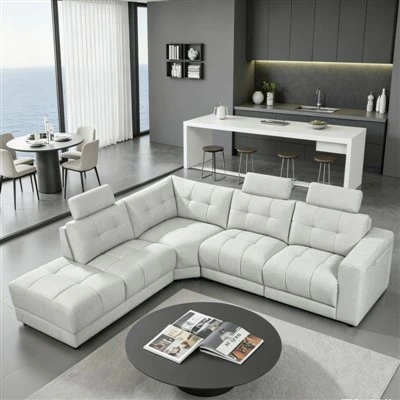
A quick-assembly modular structure enables a level of configuration flexibility that is difficult to achieve with conventionally assembled sofas. Because sections connect and disconnect quickly, the same components can be configured in dozens of layouts: a straight three-seater, an L-shape with left or right chaise, a U-shape, a corner unit with ottoman, or a custom configuration for an unusual room shape.
This flexibility benefits both the buyer and the end user. For retailers, it means a smaller inventory of standard components can serve a wide range of customer configurations, reducing stock-keeping units (SKUs) and inventory carrying costs. For contract buyers, it means the same seating system can be specified across multiple rooms with different layouts, simplifying procurement and maintenance. For end users, it means the sofa can adapt as their needs change - a new baby, a home office conversion, a move to a larger space - without requiring a new furniture purchase.
The connector system is the enabler of this flexibility. A connector that is strong, self-aligning, and tool-free allows users to reconfigure their sofa confidently, without fear of damaging the connectors or the frame. JSC's patented quick-assembly structure (ZL 2024 2 2416016.2) is designed to support this level of reconfiguration while maintaining the structural rigidity of a conventionally bolted joint.
Conclusion
Quick-assembly modular sofa structures address one of the most persistent cost and logistics challenges in the furniture industry: shipping, storing, and installing bulky upholstered seating. By enabling flat-pack shipping and tool-free on-site assembly, these structures reduce freight costs, lower damage rates, simplify last-mile delivery, and give buyers the flexibility to reconfigure seating as needs change. JSC's CNIPA Utility Model Patent ZL 2024 2 2416016.2 - a self-developed design with a maintained legal status - provides a legally protected, formally examined foundation for offering this capability to B2B clients.
Ready to reduce logistics costs with quick-assembly modular sofas? Contact the JSC engineering team for assembly demonstrations, packaging specifications, and a customized quotation. Get a Quote now.
By JSC Engineering Team. JSC (Huizhou Lanmasen Technology Co., Ltd.) manufactures functional sofas and mechanism components for global B2B clients. This article provides general technical and logistics information and does not constitute a warranty or guarantee of specific cost savings.