

Electric Recliner Sofa: Motor QC and US Compliance
For US furniture wholesalers and importers, a failed recliner motor can turn an attractive showroom sample into a costly warranty problem. The mechanism may work perfectly during a brief demonstration, yet fail after repeated use because of a weak wiring connection, overheating switch, poorly synchronized actuators, or an unsuitable power supply. Regulatory oversights can create a second problem: furniture that looks finished but arrives with missing labels or incomplete compliance records.
This guide examines the motor and electrical checks buyers should require before shipment, the US flammability and labeling rules that apply to upholstered furniture, and the documents worth verifying before approving a bulk order. The aim is practical risk control-not simply collecting a test report or ticking a box on an inspection form.
1. Motor QC Checkpoints for Wholesale Electric Recliner Sofa Orders
For a commercial grade electric recliner sofa, motor quality should be assessed as a complete operating system. The actuator, control switch, wiring harness, power adapter, connectors, moving frame and upholstery clearance all affect performance. A motor certificate alone does not establish that the finished sofa operates safely and consistently.
Test the assembled mechanism, not just the motor
Ask the factory to demonstrate the finished unit using the production-intended motor, control box, wiring, transformer or power adapter, and frame. A motor tested separately may perform correctly while the installed system suffers from cable pinching, excessive mechanical resistance or misalignment.
During pre-shipment inspection, require the inspector to verify the following:
Full operating travel: Run each reclining position from fully closed to fully extended and back. Check for hesitation, abnormal noise, sudden stops, jerking and inconsistent return speed.
Dual-motor synchronization: Where the backrest and footrest use separate actuators, operate them repeatedly and check that the intended movement sequence remains consistent. Confirm that one actuator does not stall while the other continues to move.
Wiring and connectors: Inspect crimps, terminals, insulation, strain relief and routing near hinges or scissor mechanisms. Cables must not rub against sharp metal edges or enter the mechanism's moving path.
Switch and control response: Check whether buttons stick, require excessive pressure, respond intermittently or continue sending a command after release. Test USB charging or other integrated electrical features separately if supplied.
Abnormal heat, smell or sound: Stop testing if a switch, connector, adapter or motor develops an unusual burning smell, visible discoloration, smoke or excessive heat. Do not treat these symptoms as cosmetic defects.
Power interruption and restart: Agree on the expected behavior if power is disconnected during movement, then verify it against the approved product design. Do not assume every model includes battery backup or a manual return function.
The inspection report should identify the model, motor and control-box part numbers, power supply rating, test date, sample quantity, observed defects and corrective actions. Photos should show the actual components installed in the inspected unit-not only catalog images supplied by a component vendor.
Specify cycle testing before production begins
A short demonstration confirms basic operation; it does not establish long-term endurance. Buyers should agree on a cycle-test protocol with the factory before bulk production. Define what constitutes one cycle, the number of cycles required, the load and operating conditions, the inspection intervals, and the acceptance criteria.
There is no single universal cycle count that automatically qualifies every powered sofa for US sale. The required protocol should be based on the intended application, supplier evidence, applicable product standards and the buyer's contract. A test that uses an unloaded mechanism may also miss problems that emerge when the sofa carries a realistic occupant load.
Record failures such as actuator stalls, loose connectors, abnormal noise, switch malfunction, frame deformation and changes in operating speed. If the factory replaces a component after a failure, document the replacement and retest the revised configuration. A passed test on an earlier motor or control-box version should not automatically be applied to a changed production design.
Recall history shows why electrical details deserve attention. In 2026, the CPSC announced a recall involving Joy Furniture sofa and recliner models after power switches reportedly malfunctioned and overheated, creating a fire hazard. The CPSC has also published recalls involving overheating power switches and lithium-ion batteries in powered reclining furniture. These cases do not establish a failure rate for the industry, but they demonstrate that seemingly small electrical components can become significant product-safety risks. See the official 2026 Joy Furniture recall notice.
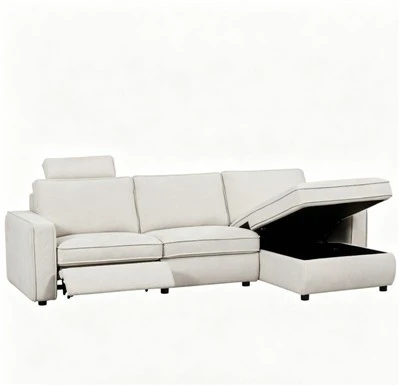
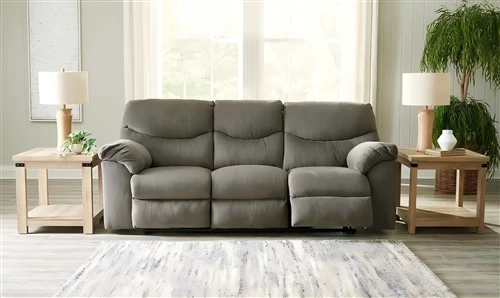
For a production reference, buyers can review the construction and configuration of this 3-seater fabric powered recliner sofa. The approved sample should match the production bill of materials, including the motor, control system, wiring layout and upholstery around moving parts.
Fabric and mechanism checks must happen together
Fabric selection can affect operation. Excess material around the footrest, a poorly secured dust cover, thick seams near a pivot point or an incorrectly positioned skirt can snag during movement. Inspect the sofa in both the upright and fully reclined positions, paying attention to fabric tension, stitching, exposed hardware and clearance around the moving frame.
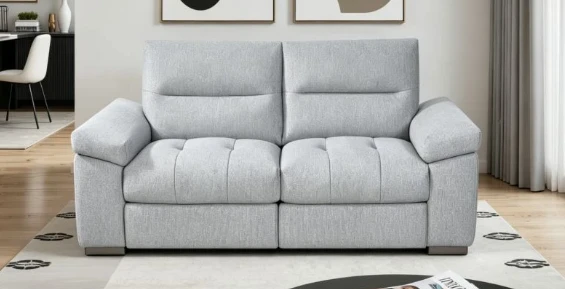
For a fabric electric recliner sofa for wholesale, confirm that the approved fabric, foam and upholstery construction remain consistent between the sample and production lot. A change in fabric thickness or backing may affect fit even when the motor specification remains unchanged. Keep the signed sample, approved bill of materials and final inspection report together so that any deviation can be traced before shipment.
2. US Compliance Rules for Fabric Recliner Sofa Imports
Electrical performance and upholstered-furniture compliance are separate questions. A successful motor test does not prove that the upholstery meets flammability requirements, and a compliant fabric test does not prove that the powered mechanism is safe.
Federal upholstered-furniture flammability requirements
The US Consumer Product Safety Commission (CPSC) explains that 16 CFR Part 1640 incorporates California Technical Bulletin TB 117-2013 for covered upholstered furniture. The federal rule became effective for products manufactured, imported or reupholstered on or after June 25, 2021; its permanent-label requirement took effect on June 25, 2022. The standard evaluates relevant upholstery components, including cover fabric, resilient filling, barrier material and decking material where applicable. A product may meet the requirements through qualifying component combinations described by the rule. Buyers should review the actual construction and test evidence rather than assume that a fabric supplier's general statement covers the entire sofa. See the CPSC upholstered-furniture FAQ.
Covered products must carry the permanent label statement:
"Complies with U.S. CPSC requirements for upholstered furniture flammability."
The label must be securely attached so that it remains in place through distribution and merchandising. A hangtag or zip tie does not satisfy the federal permanent-label requirement. The CPSC recommends that the statement be conspicuous and legible. Confirm the wording and placement on the finished product before packing; a loose label inside the carton is not an acceptable substitute. The official rule is available at 16 CFR Part 1640.
California labels and flame-retardant disclosures
If the furniture will be offered for sale in California, importers should also check the state's upholstered-furniture law-label requirements and flame-retardant chemical disclosure rules. California's requirements are additional to the federal flammability certification label; one label does not automatically replace the other. The state's guidance describes requirements for label attachment, durability, visibility, language and prescribed label formats. The flame-retardant disclosure must accurately reflect the product's materials and applicable rules.
Do not let the factory mark a disclosure based only on a generic fabric data sheet. Obtain material declarations from the relevant suppliers and confirm that they match the actual upholstery, filling and other covered components in production. For the official requirements, consult the California Bureau of Household Goods and Services (BHGS) documents on official law-label requirements and SB 1019 flame-retardant disclosures.
Power-operated recliners: warnings and electrical documentation
Buyers often ask whether there is one universal federal warning label specifically required on every electric recliner sofa. Do not assume that such a blanket rule applies. Labeling duties depend on the rules applicable to the product and its components, while specific hazards may create additional obligations. For example, a product containing a regulated battery or another component subject to a separate safety rule may require additional documentation or labeling.
Even when a particular warning label is not universally mandated, the finished product should have clear user instructions addressing safe operation, pinch points, keeping children away from moving mechanisms, and disconnecting power before servicing where appropriate. Treat these as risk-control and product-documentation measures, and have the importer or qualified compliance professional confirm the exact language for the intended market. Do not describe a voluntary warning as a federal legal requirement unless the relevant rule supports that claim.
Ask suppliers to identify the applicable electrical components and provide traceable model numbers, ratings and test documents. A logo or certificate image on a motor is not enough: verify that the document covers the exact component supplied and that its ratings suit the intended assembly. If the sofa includes a lithium-ion battery, USB charging module or powered accessories, review those components separately rather than assuming the upholstery assessment covers them.
What happens when compliance is overlooked?
Missing or inaccurate labels, unsupported compliance claims, or a product that fails an applicable safety requirement can lead to shipment delays, corrective labeling or rework, detention or refusal of entry where applicable, recalls, and potential civil penalties or other enforcement action. Contract disputes and retailer chargebacks may add further costs. The precise consequence depends on the violation, the responsible party, and the applicable law; it should not be reduced to a single assumed penalty amount.
For most regulated consumer products subject to CPSC certification requirements, importers should also review the current General Certificate of Conformity (GCC) rules. However, the CPSC specifically states that a GCC is not required solely to demonstrate compliance with 16 CFR Part 1640; the federal permanent label is required under that rule. Other applicable product-safety rules may create separate certification duties. Check the CPSC's GCC guidance and list of rules requiring a GCC rather than requesting a certificate that does not apply or assuming no certification is needed at all.
3. How to Vet Factory Inspection Reports Before Bulk Orders
A credible inspection package should let a buyer connect the report to the exact product being purchased. Before approving a bulk order, compare the model number, factory, test date, component identifiers and product configuration across the report, sample, bill of materials and purchase order. If the factory has changed the motor, switch, adapter, wiring harness, upholstery material or frame design since testing, ask whether the existing evidence still applies.
A useful report includes:
The test scope and procedure, including the definition of a cycle and the pass/fail criteria.
The quantity and identity of samples tested, with serial numbers or other traceable identifiers where available.
The measured results, observed failures, photographs and corrective-action records.
The laboratory or inspection company's full identity and contact details, where a third party was used.
The test standard and its edition, along with a clear statement of what the report does-and does not-cover.
A factory-issued report is not automatically invalid: internal production testing is useful for routine control. However, it should not be represented as an independent third-party laboratory report. For a higher-risk component or a new design, consider independent testing by a qualified laboratory, and confirm the lab's scope and accreditation for the specific test. For general-use products, US rules do not automatically require every test to be performed by a CPSC-accepted laboratory; the requirement depends on the applicable rule. Do not confuse that distinction with the stricter third-party testing regime that applies to many children's products.
For practical purchasing, buyers can use the 3-seater fabric electric recliner sofa product reference to identify the intended configuration, then request matching production records and inspection evidence. A second natural reference point is this fabric electric recliner sofa for wholesale sourcing, which buyers can use when discussing upholstery and powered-function requirements with a supplier. Before placing the order, make the final approved specification and test protocol part of the purchase agreement.
The main takeaway is straightforward: do not approve a powered sofa based on appearance, a brief demonstration or an unverified certificate alone. Confirm the complete operating system under an agreed test protocol, check that the upholstery and labels meet the rules for the destination market, and keep traceable evidence for the exact production configuration. These steps will not eliminate every defect, but they make problems easier to detect before shipment and easier to investigate if a claim arises later.
Sources
U.S. Consumer Product Safety Commission (CPSC) - Upholstered Furniture FAQ. Federal upholstered-furniture flammability and labeling requirements.
Electronic Code of Federal Regulations (eCFR) - 16 CFR Part 1640. Federal upholstered-furniture flammability standard.
CPSC - General Certificate of Conformity. Guidance on certification duties for applicable general-use consumer products.
CPSC - Rules Requiring a GCC. Official list of rules that require a GCC.
California Bureau of Household Goods and Services (BHGS) - Official Law-Label Requirements. California upholstered-furniture law-label requirements.
California BHGS - SB 1019 Industry Advisory. Flame-retardant chemical disclosure guidance.
CPSC - 2026 Joy Furniture Recall Notice. Example of a reported power-switch overheating hazard in powered reclining furniture.