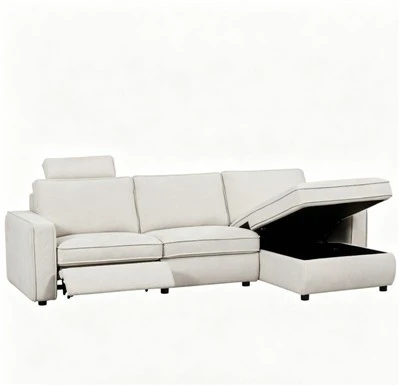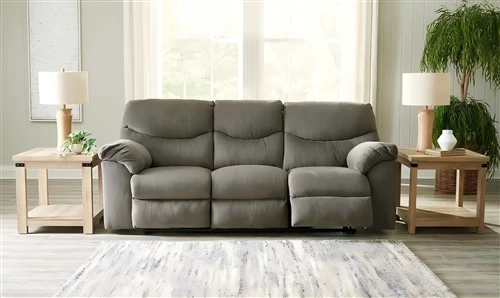

Storage Sofa Compliance and QC Guide for US Buyers
Introduction
A bulk shipment of storage sofa products can pass a factory's visual inspection and still create expensive problems after arrival in the United States. Missing upholstery labels, incomplete traceability records, inconsistent fabric specifications, or a storage lid that fails during use can expose importers to receiving delays, retailer chargebacks, warranty claims, and costly returns. California-bound inventory requires particular attention because upholstered furniture may be subject to state-specific flammability, labeling, and registration requirements.
For wholesale buyers, compliance should be verified before production-not treated as paperwork to collect after the container has been loaded. The purchasing team needs to confirm which rules apply to the finished product, which party is responsible for each label, and whether the production materials match the samples and supporting test documentation.
This guide explains the principal US and California compliance issues, the factory quality-control checkpoints that matter for bulk orders, and a practical inspection process for evaluating a wholesale storage sofa supplier. It distinguishes legal requirements from additional quality thresholds that buyers and factories can negotiate contractually.
Key US & California Compliance Rules for Imported Storage Sofa
1. Federal flammability requirements: TB 117-2013 and 16 CFR Part 1640
For most upholstered seating products within scope, the federal upholstered-furniture flammability standard in 16 CFR Part 1640 incorporates California Technical Bulletin 117-2013 (TB 117-2013). The Consumer Product Safety Commission (CPSC) explains that the standard addresses smolder resistance in cover fabrics, barrier materials, resilient filling materials, and decking materials. The applicable tests depend on the materials and construction used in the product.
This matters when sourcing a storage sofa because two visually identical models can have different internal constructions. One may use a compliant barrier around the filling, while another relies on the performance of the cover fabric and filling material. A fabric certificate alone does not establish that every component or the finished construction meets the applicable requirements.
For buyers, the practical steps are to:
Request test documentation that identifies the relevant materials, model, and construction-not simply a generic certificate from the fabric mill.
Confirm that the tested fabric, foam, barrier, and decking correspond to the production bill of materials.
Require written approval before the factory substitutes any material that could affect compliance.
Keep approved samples, supplier declarations, test reports, and production records linked to the purchase order.
The permanent federal flammability label is also important. Under 16 CFR § 1640.4(b), covered upholstered furniture must carry the statement: "Complies with U.S. CPSC requirements for upholstered furniture flammability." The labeling requirement took effect on June 25, 2022, for furniture manufactured, imported, or reupholstered on or after that date. The standard's substantive requirements took effect on June 25, 2021.
A buyer should inspect the actual label on a production-representative unit. A report in a supplier's email folder does not correct a missing or illegible label on the goods. Depending on the circumstances, a labeling defect can require corrective action, relabeling, delayed distribution, or other compliance measures.
2. California law labels, registration, and tracking
California has additional requirements for upholstered furniture sold in the state. The California Bureau of Household Goods and Services (BHGS), part of the Department of Consumer Affairs, publishes official guidance on law labels, flammability labels, and industry licensing.
For covered products, the law label identifies the filling materials and includes prescribed certification wording. Depending on the sofa's cushion construction, the applicable label format may differ. California's official labeling guidance explains that the label must be securely attached, legible, and accessible for examination; it cannot simply be replaced by a removable shipping tag.
For wholesale buyers, investigate these common documentation gaps:
Missing or incorrect registry number: California law requires the applicable registry number on the law label. Verify it against the responsible business and relevant licensing records.
Incorrect filling descriptions: The label must accurately describe the filling materials. A generic description that does not match the actual cushion or body construction can create a labeling issue.
Poor label attachment: A label that tears off during handling or is hidden beneath inaccessible upholstery may fail the applicable requirements.
Uncontrolled private-label artwork: Changing the importer name, factory details, filling description, or label layout without regulatory review can create inconsistencies between the physical product and its records.
The term tracking label needs careful interpretation. The federal permanent flammability certification label and California's law label serve distinct purposes. Buyers should also maintain commercial traceability records-such as model numbers, production lots, factory identity, dates, and shipment references-to help isolate affected goods if a defect is found. Do not assume that one label automatically satisfies every legal or retailer-specific requirement.
California's Business and Professions Code § 19094 addresses upholstered-furniture flammability and related chemical requirements, including restrictions on covered flame-retardant chemicals above specified concentration levels. The state's upholstered-furniture rules also interact with the federal standard. Federal law preempts certain state and local upholstered-furniture flammability requirements, so buyers should not treat every California rule or bulletin as an independent additional fire-test standard.
One important clarification for sourcing teams: "CA 93040" is not the California upholstered-furniture compliance citation identified in the official sources listed below. The relevant references include TB 117-2013, 16 CFR Part 1640, and applicable provisions of the California Business and Professions Code. If a retailer, testing laboratory, or supplier cites "CA 93040," ask for the complete standard title and issuing authority before adding it to a purchase specification.
3. What the rules mean for purchase orders
A compliance clause should identify responsibilities instead of stating only that products must meet "US standards." For each order, agree in writing on:
The destination states and applicable product requirements.
Who supplies and verifies the California law label and federal flammability label.
Which party obtains the required test evidence and maintains supporting records.
Whether the buyer must approve substitutions to fabric, foam, barrier material, decking, or upholstery construction.
Who pays for retesting, rework, replacement labels, sorting, or other corrective actions if a factory change causes a failure.
These are purchasing controls, not a guarantee that a shipment will never be inspected or delayed. Customs clearance also depends on import documentation and other applicable requirements. Still, a documented compliance process reduces the chance that a shipment reaches a warehouse before the buyer discovers a preventable product or labeling problem.
Critical Factory QC Checkpoints & Common Pitfalls for Wholesale Storage Sofa
Regulatory compliance is only one part of a successful order. The storage mechanism introduces moving parts, concentrated loads, pinch points, and additional assembly interfaces that ordinary fixed-frame seating may not have. A sample can look excellent in a showroom but reveal weaknesses after repeated opening, uneven loading, or long-distance transportation.
For a wholesale storage sofa program, inspect the complete functional assembly-not just the upholstery and exterior finish.
1. Storage compartment construction and load support
The storage cavity often removes space that would otherwise be occupied by a solid frame or support structure. If the factory compensates with undersized rails, poorly secured panels, or inconsistent fasteners, the compartment may flex under load or loosen over time.
During inspection, check:
Frame and panel integrity: Examine corners, cross-members, fasteners, and joints around the compartment. Look for splitting, gaps, loose staples, exposed sharp edges, or movement under normal operating loads.
Base support: Confirm that the storage floor is supported as specified in approved drawings. A thin panel spanning too wide a distance can sag even when the outside looks sound.
Upholstery clearance: Check that fabric, lining, and batting do not obstruct the storage cavity or become trapped between moving parts.
Dimensional consistency: Compare internal dimensions, usable depth, and lid alignment with the approved sample. Excess fabric or misplaced brackets can reduce usable space without changing external dimensions.
For a commercial grade storage sofa, specify the intended storage load and the method used to verify it. The acceptance threshold should reflect the product's design, intended use, and applicable safety assessment. Do not describe an arbitrary load test as a universal legal requirement.
2. Hinge durability, lid control, and gap safety
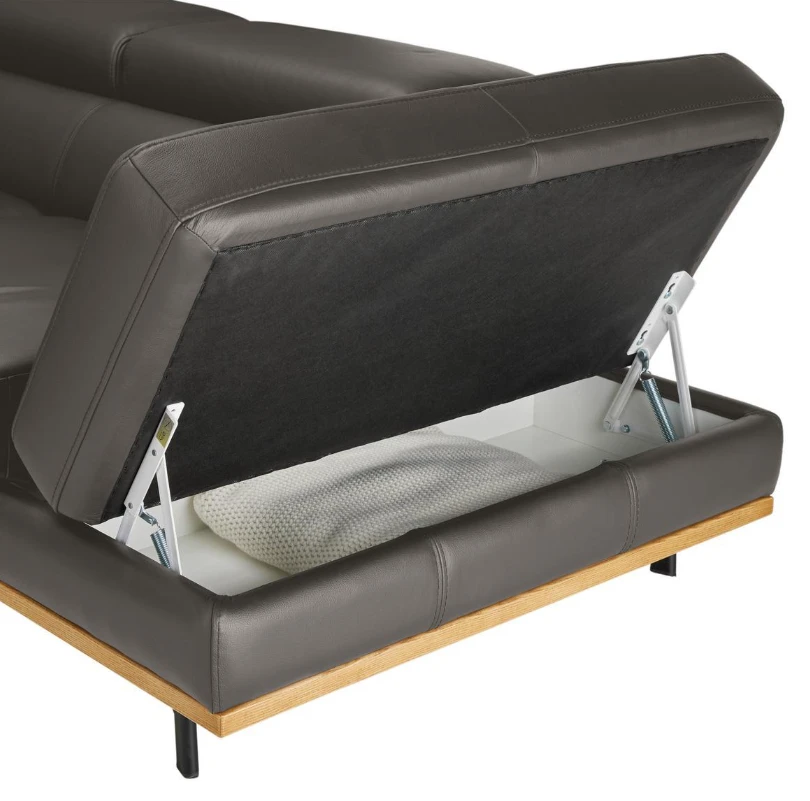
The lid assembly deserves particular attention because failures can affect both product life and user safety. A hinge that loosens, a support mechanism that does not hold the lid reliably, or an exposed gap that traps fingers can turn a low-cost component issue into a warranty or liability problem.
Inspect opening and closing behavior: the lid should move through its intended travel without binding, scraping the frame, or shifting sideways. If the design uses gas springs or another assisted-opening mechanism, verify that both sides operate consistently where applicable.
Inspect retention and attachment: check mounting screws, brackets, reinforcement blocks, and the surrounding frame. Loose fasteners after a short trial can indicate weak substrate material, insufficient engagement, or an assembly problem. Do not accept a mechanism that appears stable only because upholstery is holding it in position.
Examine pinch and shear points: observe the entire movement path, including the hinge side and the space between the lid and sofa body. Evaluate foreseeable contact points under intended use and applicable safety requirements. A simple visual check cannot establish that a design is safe; higher-risk mechanisms may warrant an engineering review and documented testing.
A useful purchase-order control is to define an agreed cycle-test protocol before mass production. For example, a buyer and factory might negotiate a specified number of opening-and-closing cycles, the test load, inspection intervals, and acceptable wear. Those values are contractual QC thresholds, not automatically mandated by TB 117-2013 or 16 CFR Part 1640.
3. Fabric compliance and production substitutions
Fabric is a frequent source of discrepancy between approved samples and bulk production. A supplier may offer a replacement fabric with a similar color, hand feel, and price, while its composition, backing, finish, or test history differs.
For upholstery subject to TB 117-2013, buyers should verify that the applicable test evidence supports the actual construction. CPSC guidance addresses testing of cover materials, including leather and related upholstery materials, as well as other relevant components.
Use a material approval matrix containing:
Fabric supplier and article number, composition, color code, backing or finish.
Relevant test report, foam specification, and barrier material where used.
Written authorization requirements for substitutions.
For California-bound inventory, the purchasing team should separately review applicable flame-retardant chemical restrictions and required labeling. Passing a smolder-resistance test does not, by itself, establish compliance with every chemical restriction or labeling rule.
This control is particularly important when importing a storage sofa as part of a multi-SKU program. If one colorway uses a different fabric construction, it may need separate supporting evidence. Do not assume that a report for one material automatically covers every color, backing, foam combination, or finished model.
4. Packaging, assembly, and shipping damage
The storage lid and its hardware can also be vulnerable during transit. If the lid shifts inside the carton, the hinge may deform, the upholstery may be compressed, or the corners may be damaged before the shipment reaches the distribution center.
Inspect the packed unit as well as the assembled sofa. Confirm that loose hardware is secured, the lid is restrained, protective materials cover vulnerable edges, and the packaging matches the approved packing specification. For knock-down designs, verify that instructions, fastener packs, and assembly diagrams correspond to the exact model.
Buyers should document carton condition before opening it and photograph any damage found during inspection. This creates a useful record for separating factory defects from transit damage when discussing claims with the supplier, freight provider, or insurer.
Quick Pre-Shipment Audit Checklist for Buyers
Use the following checklist as a practical starting point for the storage sofa factory inspection checklist. Expand it according to the model's risk profile and the retailer's written requirements.
Compliance and documentation
☐ Confirm applicable federal flammability documentation and material traceability.
☐ Verify permanent federal flammability label wording and attachment.
☐ Review California law label, filling description, and applicable registry details.
☐ Match production materials to approved samples and test evidence.
Structure and mechanism
☐ Inspect frame joints, storage floor, supports, and fasteners.
☐ Open and close the lid repeatedly; record binding, noise, or misalignment.
☐ Check hinge and support attachments for movement or loosening.
☐ Review accessible gaps, pinch points, and lid-control behavior.
Finish and shipping
☐ Compare dimensions, fabric color, seams, and upholstery with the golden sample.
☐ Check storage capacity and lid clearance against approved drawings.
☐ Verify carton protection, hardware packs, and assembly instructions.
☐ Photograph defects and record model, carton, and lot identifiers.
Sampling matters. Agree on the inspection level, sample-selection method, defect classifications, and acceptance criteria before the inspection begins. If the order uses AQL sampling, specify the applicable sampling plan and critical, major, and minor defect limits in the purchase order. AQL is a negotiated inspection framework; it is not a legal certification or proof that every unit is defect-free.
For higher-risk findings-such as a missing required label, a material mismatch, or a lid mechanism that presents a potential injury hazard-do not rely on an overall pass percentage to override the issue. Hold the affected goods, investigate the cause, and document corrective action before release.
Sourcing decisions that protect the order
A successful bulk purchase depends on connecting compliance documents to the actual production unit. The approved sample, material specifications, factory inspection records, and shipping documentation should all identify the same model and construction.
Before placing a repeat order, review the supplier's corrective-action history. Ask whether previous defects were caused by weak hinge mounting, material substitutions, incorrect labels, or packaging failures-and what changed in the production process afterward. A supplier's willingness to document root causes is more useful than an unsupported claim of zero defects.
For buyers comparing models, review the storage sofa for living room range alongside the wider functional sofa sourcing guide. Before committing to wholesale quantities, request the relevant test reports, label artwork, approved material list, engineering drawings, and a documented pre-shipment inspection plan.
The goal is not simply to purchase a sofa with storage. It is to establish a repeatable sourcing process that limits avoidable compliance issues, mechanism failures, and downstream warranty costs.
Sources
U.S. Consumer Product Safety Commission (CPSC) - Flammable Fabrics Act and upholstered-furniture guidance. Official overview of federal flammability requirements and certification responsibilities.
https://www.cpsc.gov/Business--Manufacturing/Business-Education/Business-Guidance/Flammable-Fabrics-Act
CPSC - Business Guidance FAQ: Upholstered Furniture. Explains TB 117-2013, testing scope, implementation dates, and the permanent federal flammability label.
https://www.cpsc.gov/Business--Manufacturing/Business-Education/FAQ?p=3019&tid%5B3038%5D=3038
Electronic Code of Federal Regulations - 16 CFR Part 1640, Standard for the Flammability of Upholstered Furniture. Official federal regulation, including certification, labeling, and preemption provisions.
https://www.ecfr.gov/current/title-16/chapter-II/subchapter-D/part-1640
California Bureau of Household Goods and Services (BHGS) - Upholstered Furniture and Bedding Labels FAQ. Official California guidance on law labels, flammability labels, attachment, and visibility.
https://bhgs.dca.ca.gov/forms_pubs/labels_faq_0619.pdf
California BHGS - Official Law Label Requirements. Label formats and required information for upholstered furniture, including filling descriptions and registry information.
https://bhgs.dca.ca.gov/forms_pubs/labeling_req_faq.pdf
California BHGS - Home Furnishings and Thermal Insulation Laws and Regulations. Official statutory and regulatory reference covering labeling, registry numbers, and other requirements for regulated home furnishings.
https://bhgs.dca.ca.gov/laws/hfti_law_book-effective-1-1-24.pdf
California Legislature - AB 2998, Consumer Products: Flame Retardant Materials. Legislative source for California restrictions on specified flame-retardant chemicals in covered consumer products.
https://leginfo.legislature.ca.gov/faces/billVersionsCompareClient.xhtml?bill_id=201720180AB2998&cversion=20170AB299894AMD