

The Low Armchair: A High-Value SKU for Global Furniture Wholesalers and Hospitality Buyers
For furniture wholesalers, importers, and buying managers, the seating category has quietly split into two very different businesses: the race to sell big statement sofas, and the quieter, more predictable one of selling the right accent chair. On the commercial side, the numbers are worth a closer look. The global hotel armchair market was valued at roughly $4.99 billion in 2025 and is projected to reach about $8.29 billion by 2034, a compound annual growth rate near 5.8% [1]. Broader lounge furniture sits at an even larger scale, estimated around $68.45 billion in 2025 and forecast to climb toward $99 billion by 2032 at a CAGR of roughly 5.4% [2]. Accent and lounge seating is not a side line; it is a dependable, repeat-order category that wholesalers carry precisely because the demand is steady and the margin is healthy.
Within that category, the low armchair has become one of the most dependable sellers for wholesale distribution. Its appeal is structural, not a passing trend. A compact seat profile works across the three spaces that buy furniture in volume: hotel lobbies and guest lounges, reception and waiting areas, and retail showrooms where it pairs with sofas to lift average order value. This guide is written for professional buyers who source upholstered seating for retail, hospitality, and project orders. It walks you from the market trend that explains why low-profile seating sells, through the dimension benchmarks that keep container fill efficient, the QC checkpoints that protect your margin, the compliance rules that keep shipments moving through customs, and the merchandising tactics that turn a modest armchair into a repeat-order line.
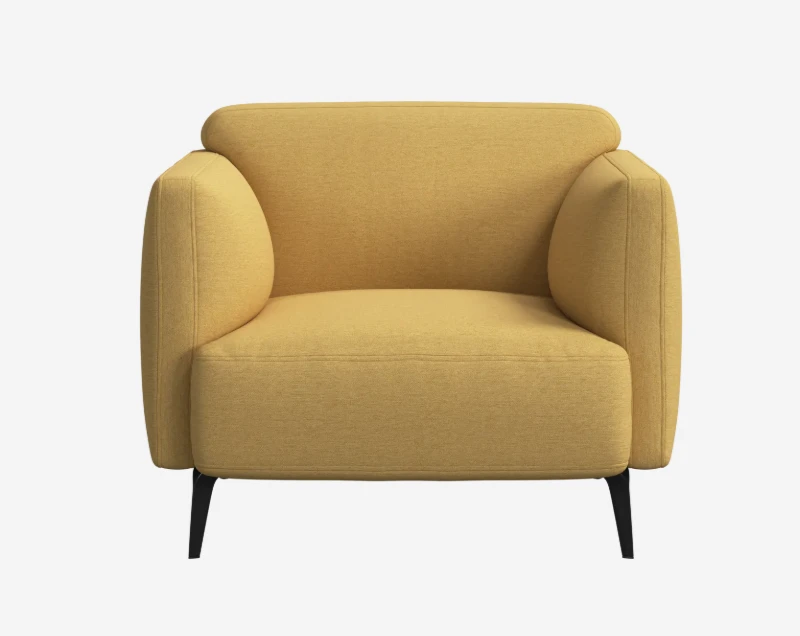
What Makes a low armchair a High-Demand SKU for Global Furniture Wholesalers
To understand why the low armchair sells so consistently, it helps to look at how spaces have changed rather than how armchairs have changed. Open-plan lobbies, co-working lounges, boutique hotel suites, and modern apartments all favor lower sight lines and relaxed, approachable seating. A lower seat height reads as casual and welcoming, which is exactly what hospitality designers are asked to deliver. At the same time, a low-profile piece occupies less visual bulk than a full-height lounge chair, which matters in tighter floor plans where buyers are measuring every centimeter.
The wholesale advantage is twofold. First, a low seat height tends to mean a smaller overall footprint, and smaller footprints translate directly into better container fill rates. When you are importing in volume, a chair that packs more units per container lowers your landed cost per piece even if the unit price is unchanged. Second, the category is order-driven rather than trend-driven: hotels and offices reorder accent seating in batches for new properties and refurbishments, giving wholesalers a pipeline of predictable demand rather than a one-time surge. From a buyer's perspective, that is a much safer inventory bet than chasing a style peak.
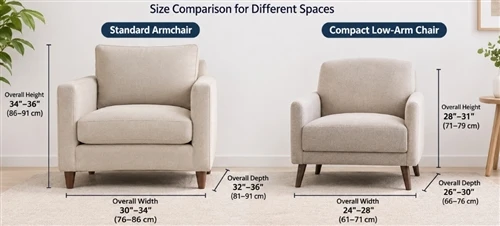
There is also a practical sizing nuance worth understanding before you commit to stock. A low-profile chair is not merely a shorter chair; it is a chair engineered around a lower seating plane. Standard accent and lounge chairs typically sit with a seat height around 17–19 inches (43–48 cm), while true low-profile lounge chairs drop to roughly 14–17 inches (36–43 cm) [3]. That difference matters to your hospitality clients, who use seat height to control the casual feel of a lounge, and it matters to you, because it changes the ergonomics, the frame geometry, and the cushion spec you must specify. A buyer who understands this distinction can brief a factory precisely instead of accepting a generic catalog drawing.
Critical Dimension Benchmarks & Space Planning for Wholesale low armchair Orders
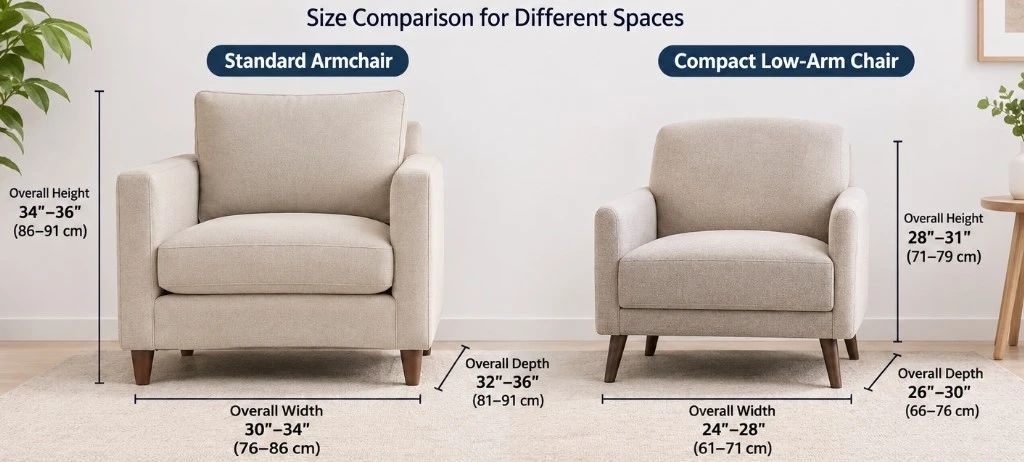
Dimension control is where good wholesale sourcing decisions are made, because every inch affects container fill, freight cost, and end-user satisfaction. For a low armchair destined for retail and hospitality channels, the practical specification ranges to compare against factory drawings are well documented. A typical compact accent chair runs 27–29 inches wide, 29–31 inches deep, and 30–32 inches tall, with a 17-inch seat [4]. Slightly larger lounge models range 30–40 inches wide, 30–40 inches deep, and 30–40 inches tall [5]. The key is not to memorize a single number but to lock a target window into your specification sheet and reject anything outside it.
Three dimensions deserve your attention before approval, because they drive the two costs you care most about: freight and returns. Overall width determines how many units fit side by side in a carton and across a container floor; the difference between a 28-inch and a 32-inch chair can shift container yield noticeably. Seat depth controls comfort and, critically, how much packing material the carton needs for protection. Seat height drives both ergonomics and the perceived value of the piece. When you compare quotes, always compare the same dimension set, not just the price; a cheaper chair that is two inches wider costs you more per container and may not fit your client's planned layout.
Space planning for your wholesale customers is another place you can add value without adding cost. Provide your retail and hospitality partners with clearance guidance alongside the product: a good rule of thumb is to allow roughly 24–30 inches of layout space in front of and around an accent chair for comfortable movement and placement [6]. Handing buyers a ready-to-use clearance figure makes their planning easier and reduces the chance they order a piece that does not fit the space - which, in turn, reduces the returns that eat your margin.
Upholstery, Frame and Foam QC Checklist for Commercial-Grade Low Armchairs
Once the dimensions are locked, the margin risk moves to what you cannot see in a photograph: the frame, the foam, and the fabric. For wholesale low armchair programs sold into hospitality and retail, durability is not a nice-to-have; it is the difference between a reliable repeat line and a steady stream of warranty claims. The commercial reference point is BIFMA X5.4-2020, the Public and Lounge Seating standard that covers waiting, reception, lounge, and gathering-area seating - exactly the settings where a low-profile chair earns its keep [7]. Building your inspection requirements around a recognized standard gives you a defensible baseline when you negotiate with a factory.
Start with the frame. For commercial-grade seating, hard maple or kiln-dried hardwood frames with properly glued and doweled joints are the benchmark; engineered wood and softwood frames can flex and squeak under repeated use in a busy lobby. The inspection point is not just the type of wood but the joints: corners should be double-doweled and reinforced, and there should be no visible gaps or loose fasteners after assembly. A frame that feels solid in a sample may still drift in production, so include frame joint inspection in your pre-shipment checklist rather than relying on the first sample.
Foam is the second and most underrated failure point. High-traffic seating should use high-resiliency (HR) molded foam, and the practical density floor for lounge seating is roughly 2.5–3.0 lb per cubic foot (about 40–48 kg/m³) [8]. The reason density matters to you is what happens when it is too low: foam 'bottoms out' over time, the cushion flattens, the chair loses its supportive feel, and the customer complains - not about the frame, but about comfort. Comfort complaints are expensive because they are subjective and hard to argue with. Specify the foam density in your purchase order, not just the appearance, and ask for fatigue-test data on the cushion core.
Fabric is the third check, and the one your hospitality clients will notice first. Lounge chairs in lobbies and waiting areas see constant contact, so specify abrasion resistance using the recognized Martindale test (ASTM D4966 / ISO 12947). Residential fabric generally starts around 15,000 rubs, while contract and high-traffic hospitality use moves to 30,000–40,000 rubs [9][10]. For a **_low armchair_** you plan to sell into hotels and offices, 30,000 Martindale rubs is a defensible floor. Pair the abrasion spec with a stain-resistance requirement, because fabric in a reception area will be tested by coffee and spills long before it is tested by wear. Commercial grade low armchair upholstery options should be selected with both abrasion and cleanability in mind, not just color.
Global Compliance, Labeling and Shipment Risks to Avoid for Low Armchair Imports
Compliance is where a well-sourced low armchair program can be derailed by a single non-compliant shipment, so it belongs in the buying process, not after arrival. Because you sell into multiple markets as a global wholesaler, the rules you face depend on destination, and the safest approach is to map them before you commit to a factory rather than after a container is on the water.
For the United States, upholstered furniture must meet 16 CFR Part 1640, the federal standard that adopts California TB 117-2013 for smolder resistance of cover fabric, filling, barrier, and decking materials; products manufactured or imported on or after June 25, 2021 must comply, with labeling required by June 25, 2022 [11][12]. For the European market, upholstered seating typically faces EN 1021 ignitability assessment, while UK-bound product often references BS 5852 [13]. These are not interchangeable, and a compliance package that satisfies one market does not automatically clear another. Your sourcing team should confirm which set of reports each order requires based on the actual destination, not on the factory's home standard.
Beyond flammability, the labeling requirement is a frequent and easily avoidable source of port holds. Durable, sewn-in labels identifying the manufacturer or importer, filling materials, and compliance status are expected in most regulated markets. Stick-on labels are not reliable over the life of the furniture and have caused detention for buyers who assumed a printed label was enough. Include label verification in your pre-shipment inspection checklist. Also keep in mind that the importer of record carries legal responsibility for compliance even when a factory supplied a verbal assurance; third-party lab reports tied to your specific material lot are the only evidence that survives a customs review.
Shipment risk is the final compliance-adjacent issue. Because a low-profile chair is relatively compact, it is easy to over-pack a container and invite transit damage. Specify corner protection, protective covers on exposed frame or metal components, and moisture-barrier wrapping, and audit the container-loading plan before the container is sealed. A modest investment in packaging spec prevents the kind of transit damage that converts a profitable order into a claim.
Merchandising & Cross-Sell Strategies to Boost Low Armchair Turnover
For wholesalers, the low armchair is not just a single SKU; it is a merchandising lever. Because accent chairs pair naturally with sofas, they lift average order value in every retail channel. A practical assortment strategy is to offer a neutral base of low-profile accent chairs that match your sofa line in fabric and finish, then add a smaller set of accent colors for customers who want a pop. This keeps your inventory manageable while giving your retail partners a story to sell: a coordinated living room look rather than a single chair.
Hospitality buyers, by contrast, buy on consistency and reorder reliability. For hotel and office projects, the winning approach is to offer a durable low armchair for retail resale with documented test data, a clear MOQ, and a reliable reorder lead time. Projects rarely order once; refurbishment cycles create repeat demand, and the wholesaler who made reordering easy keeps the account. Provide your hospitality clients with a simple sample-approval package: the chair, the fabric swatches, and the compliance reports, all in one kit. The easier you make approval, the faster the project moves, and the faster you get paid.
From a margin standpoint, the compact footprint of a low-profile chair gives you a structural edge in freight: more units per container than bulkier seating, which lowers landed cost per piece and protects margin even when ocean rates rise. Pair that with a cross-sell strategy - always offer the matching ottoman, side table, or throw pillow - and you convert a single chair order into a multiple-line order. That is the difference between selling a product and building a category.
Conclusion
The low armchair is a textbook wholesale SKU: steady commercial demand, compact dimensions that protect freight margins, a clear set of QC benchmarks you can verify, and a natural fit for cross-sell and reorder programs. The buyers who profit from it are the ones who treat it as an engineered product rather than a style item - locking dimensions, specifying frame, foam, and fabric, mapping compliance by destination, and building a merchandising story for their retail and hospitality partners.
When you combine rigorous material testing, verified compliance documentation, and a clear assortment plan, you turn a simple accent chair into a reliable profit driver for your wholesale business. Review your target price point, container yield, and customer profile, then source the low-profile seating that fits the way your buyers actually purchase. For a deeper look at the upholstered seating range we build for wholesale and hospitality distribution, explore the armchair and lounge seating sections of our catalog.
Sources
1. Dataintelo - Global Hotel Armchair Market Report 2025–2034. https://dataintelo.com/report/global-hotel-armchair-market
2. PW Consulting - Worldwide Lounge Furniture Market 2026. https://pmarketresearch.com/worldwide-lounge-furniture-market-research/
3. Penghao Furniture - Accent Chair Dimensions Guide 2026. https://penghaofurniture.com/blogs/chairs/accent-chair-dimensions-guide
4. Homespe - What Size Accent Chair for a Small Living Room Corner. https://homespe.com/what-size-accent-chair-for-small-living-room-corner/
5. RoomFurniturs - How Big Is an Armchair: Standard Dimensions. https://roomfurniturs.com/how-big-is-an-armchair-2/
6. PrimeHomeIdeas - Living Room Chairs: Best Styles, Sizes, and Layouts. https://primehomeideas.com/living-room-chairs/
7. BIFMA - ANSI/BIFMA X5.4-2020(R2025) Public and Lounge Seating standard. https://www.bifma.org/page/StandardsShortDesc?aff=4a9sr3
8. Anji Duomei Intelligent Furniture - Durability Markers for Modern Leisure Chairs in Commercial Spaces (HR foam density 2.5–3.0 lb/ft³). https://www.duomeihome.com/news/industry-news/modern-leisure-chair-durability-commercial-spaces.html
9. ACT Association for Contract Textiles - Abrasion Voluntary Performance Guidelines (Martindale low 20,000 / high traffic 40,000). https://contracttextiles.org/learn/abrasion-disclaimer/
10. GERMES - What Is Martindale (domestic 15,000; contract 30,000). https://www.germes.com/en/what-is-martindale
11. Federal Register - Standard for the Flammability of Upholstered Furniture (16 CFR Part 1640 adopting TB 117-2013). https://www.federalregister.gov/documents/2021/04/09/2021-06977/standard-for-the-flammability-of-upholstered-furniture
12. CPSC - New Federal Safety Standard for Upholstered Furniture (TB 117-2013, label from June 25, 2022). https://www.cpsc.gov/Newsroom/News-Releases/2021/New-Federal-Safety-Standard-for-Upholstered-Furniture-Fires-Goes-into-Effect
13. CEN - EN 1021-1:2014 Furniture Assessment of Ignitability of Upholstery / BSI BS 5852. https://www.cen.eu/ and https://www.bsigroup.com/