
Gigixie brings 17 years of hands-on experience in sofa manufacturing and international furniture trade. Her expertise shapes every stage of order planning, regulatory compliance, and cross-border buyer-factory collaboration. She specializes in OEM and ODM upholstery projects, structural sofa design, packaging optimization, and bulk order risk mitigation for global furniture wholesalers, importers and hospitality procurement teams. She regularly shares practical sourcing guidance to help buyers avoid costly dimension, terminology and quality-control pitfalls.
Table of Contents
1. Why There Is No Single Most Comfortable Sofa Brand for All Wholesale Projects
2. Core Factors That Determine Sofa Comfort & Long-Term Durability for Commercial Use
3. Practical QC Checklist to Verify Sofa Comfort Before Mass Production
4. Conclusion
5. Sources
Introduction
When furniture wholesalers search for the most comfortable sofa brand(插入链接:https://www.jsc-sofa.com/), they are often looking for a reliable shortcut to product selection. A familiar brand name, positive customer reviews, or an impressive showroom sample can make a sofa appear to be a safe investment. However, commercial furniture sourcing involves a different set of considerations from buying a single sofa for residential use.
For importers, hospitality procurement teams, and retail furniture buyers, comfort must be repeatable. A sofa that feels excellent in a showroom but loses its support after several months of daily use can quickly become a costly product. The problem becomes more serious when hundreds of units arrive in different containers, and customers begin reporting inconsistent seat firmness, cushion deformation, or uncomfortable back support.
In our experience with upholstered furniture manufacturing and international trade, the most expensive mistakes rarely come from choosing the wrong fabric color. They often come from approving a sample without establishing measurable comfort and durability requirements for mass production.
This guide explains how professional buyers can assess cushion construction, foam specifications, suspension systems, ergonomic dimensions, and long-term seating performance. It also provides practical testing methods and factory inspection procedures to help buyers reduce product returns and maintain consistent quality across wholesale shipments.
The objective is straightforward: instead of choosing a supplier based on a subjective comfort impression, establish a measurable standard that can be reproduced throughout the entire production process.
Why There Is No Single Most Comfortable Sofa Brand for All Wholesale Projects
Comfort Depends on the Intended Application
A sofa designed for a residential living room does not necessarily perform well in a hotel lobby, serviced apartment, restaurant waiting area, or commercial reception space.
The reason is that comfort is influenced by several variables, including seat depth, backrest angle, cushion firmness, foam resilience, suspension design, and the expected duration of use.
Consider three common wholesale purchasing scenarios.
Scenario 1: Residential retail distribution
A furniture retailer may prioritize a soft initial sitting experience. Customers often spend several minutes testing a sofa in a showroom. A cushion with a plush fiber wrap and relatively soft foam surface can create a favorable first impression.
However, the retailer must also consider how the cushion will perform after repeated use. If the foam core has insufficient load-bearing capacity, the seat may lose its original profile, even when the fabric remains in good condition.
Scenario 2: Hotel and hospitality projects
Hotel sofas face a different operating environment. Guests may sit on the same sofa throughout the day, and users vary considerably in body weight, posture, and sitting habits.
A cushion that feels extremely soft during a short inspection may compress excessively under repeated loading. For this application, balanced support and shape recovery are generally more important than an exceptionally soft first impression.
Scenario 3: Commercial reception and waiting areas
Reception seating must accommodate different users without creating excessive pressure or discomfort.
A relatively firm cushion with appropriate seat depth and back support can be more suitable than a deep, soft residential-style sofa. It should also be easy to maintain and should retain its appearance under frequent use.
These examples demonstrate why a single comfort rating cannot accurately describe every commercial sofa.
Why Brand Reputation Is Not Enough for Wholesale Buyers
A recognizable furniture brand may offer excellent products, but its reputation does not guarantee that every model, production batch, or manufacturing specification will meet a particular buyer's requirements.
Even within the same collection, two sofas can have different comfort characteristics because of differences in:
Seat cushion foam density and indentation hardness.
Foam thickness and layered construction.
Spring type and suspension tension.
Seat depth and usable seating width.
Back cushion filling and lumbar support.
Upholstery tension and fabric characteristics.
Manufacturing tolerances and assembly consistency.
There is another important issue: brand-level comfort claims rarely provide sufficient technical information for a bulk purchasing decision.
For example, a supplier may describe a cushion as high-density foam. That description alone does not tell the buyer its actual density, indentation force, compression behavior, or expected fatigue performance.
The distinction matters because foam density and firmness are not interchangeable measurements.
Density indicates the mass of foam per unit volume, while indentation hardness measures the force required to compress a foam sample to a specified level under defined test conditions.
A dense foam can still be relatively soft. Similarly, a firm foam does not automatically have better fatigue resistance.
Professional buyers should therefore request actual material specifications rather than accepting general descriptions.
The Sample-to-Mass-Production Problem
One of the most common sourcing risks is the difference between an approved sample and the finished production batch.
A sample may be assembled using carefully selected foam, individually adjusted cushion covers, and additional manual finishing. During mass production, material substitutions, cutting variations, filling inconsistencies, or changes in assembly methods can produce a noticeably different seating experience.
A practical example involves a wholesale order of several hundred sofas.
The approved sample has a balanced seat: the upper layer feels soft, while the underlying foam provides sufficient support. During production, the supplier changes the foam supplier but maintains a similar product description.
The new foam may have a different indentation hardness and recovery behavior. Although the finished cushions look almost identical, some units feel noticeably firmer or softer.
The buyer may only discover the problem after the goods arrive at the distribution warehouse.
At that stage, sorting, replacement, customer complaints, and additional freight can cost considerably more than conducting a material verification before production.
For this reason, buyers should evaluate more than the physical sample. They should establish a written reference specification that includes the cushion construction, material supplier, foam characteristics, and acceptance tolerances.
A useful purchasing principle: brand reputation helps with initial supplier screening, but product-level specifications and production controls determine whether a wholesale order is reliable.
Core Factors That Determine Sofa Comfort & Long-Term Durability for Commercial Use
A sofa's comfort is the result of an integrated seating system. Foam, suspension, upholstery, frame geometry, and cushion dimensions must work together.
For professional buyers, the challenge is not simply finding comfortable upholstered seating. It is selecting a construction that maintains its original seating characteristics under the intended operating conditions.
1. Foam Density and Indentation Hardness
Foam is one of the most important components in upholstered seating.
Two measurements deserve particular attention:
Foam density
Density is normally expressed in kilograms per cubic meter (kg/m³) or pounds per cubic foot (lb/ft³).
It indicates the amount of material within a given volume. Density is useful when comparing foam materials of the same general type, but it should not be used as a standalone indicator of firmness.
Indentation hardness
Indentation hardness describes the force needed to compress foam by a specified percentage under a defined testing procedure.
The International Organization for Standardization's ISO 2439 standard provides methods for measuring the indentation hardness of flexible cellular materials. It includes procedures for evaluating different compression levels and load-bearing characteristics.
For buyers, this is useful because it allows foam suppliers to provide more objective information than descriptions such as soft, medium, or firm.
A related standard, ISO 3385, measures fatigue by constant-load pounding. It evaluates changes in foam thickness and hardness after repeated mechanical loading.
ASTM D3574 also provides test methods for flexible polyurethane foam, including procedures relevant to quality control and material evaluation.
Importantly, these standards assess foam specimens under defined test conditions. They do not automatically establish the durability of a complete sofa.
A finished seat also depends on cushion thickness, suspension, frame support, upholstery tension, and the way the materials interact.
2. Comparing Different Cushion Systems
Different cushion systems produce different sitting experiences and maintenance requirements.
The following comparison is intended as a sourcing reference rather than a universal ranking.
|
Cushion system |
Initial sitting feel |
Support characteristics |
Durability considerations |
Typical sourcing application |
|
High-resilience foam |
Balanced, responsive |
Consistent support when correctly specified |
Depends on foam formulation, density and fatigue performance |
Retail and commercial seating |
|
Multi-layer foam |
Soft surface with supportive core |
Allows different firmness levels within one cushion |
Layer bonding and material compatibility require inspection |
Mid-range and premium wholesale collections |
|
Foam with fiber wrap |
Softer surface feel |
Maintains a supportive foam center |
Fiber can flatten and require maintenance |
Residential retail and hospitality |
|
Pocket spring with foam |
Responsive, spring-assisted feel |
Distributed support across the cushion |
Spring integrity and surrounding foam must be checked |
Premium upholstered seating |
|
Fiber or down-blend filling |
Plush, softer feel |
More dependent on filling distribution |
Requires regular maintenance and reshaping |
Premium residential and selected hospitality projects |
High-resilience foam
High-resilience foam is often a practical choice for wholesale programs that require a balance between comfort and shape retention.
Its performance still depends on the actual formulation and manufacturing quality. Buyers should request density, indentation hardness, and fatigue test results rather than relying on the HR label alone.
Multi-layer foam
A multi-layer cushion combines different foam characteristics.
For example, a softer upper layer can improve the first-contact sensation while a firmer underlying core provides structural support.
This approach can be useful when buyers want a comfortable surface without creating an excessively soft seating base.
However, the layers must be securely bonded and dimensionally consistent. Poor bonding or incompatible foam materials can lead to separation, uneven compression, or visible deformation.
Foam with fiber wrap
Polyester fiber wrapping creates a rounded cushion profile and improves the initial softness.
It is frequently used around a foam core to create a more inviting surface.
For commercial applications, the important question is how quickly the fiber loses loft and whether the foam beneath it continues to provide adequate support.
Pocket spring cushions
Pocket spring systems provide an alternative to conventional solid foam cushions.
They can create a responsive sitting experience, but the overall performance depends on the spring specification, surrounding foam, pocket fabric, and cushion assembly.
For bulk buyers, spring placement and unit-to-unit consistency should be checked carefully.
Fiber and down-blend cushions
These cushions can create a softer, more relaxed appearance.
However, they often require more maintenance than conventional foam cushions. Filling migration, uneven distribution, and loss of loft can become practical concerns in high-traffic environments.
The correct choice depends on the project rather than the perceived prestige of a particular filling material.
3. Foam and Spring Specifications for Comfortable Upholstered Seating
When buyers evaluate foam and spring specs for comfortable upholstered seating(插入链接:https://www.jsc-sofa.com/living-room-sofa/fabric-living-room-sofa/large-size-fabric-living-room-sofa.html), they should request a complete cushion specification instead of a single foam density figure.
A useful technical specification should include:
|
Specification |
Information to request |
Why it matters |
|
Foam type |
Conventional PU, HR foam or other specified formulation |
Identifies the material construction |
|
Foam density |
kg/m³ or lb/ft³ |
Helps assess material consistency |
|
Indentation hardness |
Test method and measured result |
Indicates load-bearing behavior |
|
Foam thickness |
Actual finished thickness |
Influences compression travel and support |
|
Cushion construction |
Single-layer, multi-layer, wrapped or pocket spring |
Defines the seating system |
|
Spring specification |
Type, dimensions, wire specification and layout |
Affects support and resilience |
|
Suspension |
Sinuous springs, webbing or other system |
Determines support beneath the cushion |
|
Fatigue performance |
Test method and before/after measurements |
Helps evaluate performance after repeated loading |
Do not assume that a supplier's foam density figure is sufficient evidence of durability.
Two materials with similar density can have different indentation hardness and fatigue behavior. Likewise, two cushions using the same foam can feel different because of variations in thickness, wrapping, cover tension, or suspension.
The purchasing specification should therefore describe the complete seating assembly.
4. The Relationship Between Softness and Durability
A common mistake in commercial sourcing is treating maximum softness as the definition of comfort.
In reality, a cushion that feels extremely soft in a showroom may not provide the best long-term performance in a busy hospitality environment.
There is a practical trade-off.
|
Design characteristic |
Comfort advantage |
Potential commercial risk |
|
Very soft upper foam |
Pleasant initial sitting sensation |
May compress more noticeably |
|
Thick fiber wrap |
Plush appearance and soft surface |
Fiber may flatten or shift |
|
Deep seat |
Relaxed seating position |
May not suit shorter users or waiting areas |
|
Soft back cushions |
More relaxed upper-body support |
Can lose shape without suitable construction |
|
Firm foam core |
Better underlying support |
May feel uncomfortable if the upper layer is too hard |
|
Strong suspension |
Helps distribute seating loads |
Incorrect tension can create an overly rigid feel |
The objective is not to eliminate softness. It is to design the cushion so that the surface comfort and underlying support remain balanced.
For example, a hotel lounge sofa may benefit from a supportive foam core combined with a softer fiber-wrapped upper layer. This can provide a welcoming first impression without relying entirely on soft filling.
A deep residential-style sofa may be appropriate for some suites, but the same dimensions may be less suitable for a reception area where guests sit briefly and frequently.
5. Seat Geometry and Ergonomic Compatibility
Comfort is also affected by the relationship between seat depth, seat height, backrest angle, and cushion firmness.
A technically sound cushion can still produce an uncomfortable sofa if the geometry is unsuitable.
Seat depth
A deeper seat allows users to adopt a more relaxed position. However, excessive depth can reduce back support for shorter users.
For hospitality projects serving a wide range of guests, seat depth should be evaluated with different users rather than approved through one person's showroom experience.
Seat height
A seat that is too low can make standing up difficult, particularly for older guests or users with limited mobility.
A higher seat may improve accessibility for some users but can feel less relaxed when combined with a short seat depth.
Backrest angle
The backrest should support a natural sitting position. An overly reclined angle may be suitable for leisure seating but less practical for reception or waiting areas.
Cushion thickness
Thicker cushions do not automatically provide greater comfort. The underlying support structure, foam characteristics, and available compression travel all influence the result.
When comparing samples, buyers should record actual dimensions rather than relying on catalog descriptions.
6. Frame and Suspension: The Hidden Foundation of Comfort
A sofa cushion cannot compensate for a weak supporting structure.
The frame must distribute seating loads without excessive movement, noise, or deformation.
Depending on the product design, the frame may use solid wood, engineered wood, plywood, or a combination of materials.
Important inspection points include:
Frame material and thickness.
Joint construction and corner reinforcement.
Seat rail stability.
Spring attachment and spacing.
Webbing tension and fastening quality.
Support distribution across the seat.
Connection between the seat deck and arm structure.
Sinuous springs are commonly used in upholstered seating. Their performance depends on wire characteristics, spacing, attachment points, and the frame's ability to maintain alignment.
Webbing systems offer another construction option. However, webbing quality, tension, and fastening methods must be specified carefully.
For hotel seating, repeated loading can expose weaknesses that are not apparent during a simple visual inspection.
A sofa may initially feel comfortable because its cushions are well made, but an unstable suspension system can eventually create an uneven seating surface.
This is why the cushion and frame should be evaluated as one complete system.
7. Upholstery and Environmental Conditions
Fabric and leather also affect the seating experience.
A tightly woven fabric may feel firmer against the body than a brushed or textured upholstery material. Some coated fabrics may feel warmer or less breathable depending on their surface construction.
In hospitality environments, upholstery selection must balance tactile comfort with abrasion resistance, cleanability, and maintenance requirements.
ISO 12947-2 provides a method for determining textile fabric breakdown under the Martindale abrasion test.
It is important to understand the scope of this standard: abrasion resistance does not directly measure cushion durability or overall sofa service life.
Similarly, a high abrasion result does not guarantee that a fabric will resist every form of pilling, seam failure, staining, or environmental degradation.
Buyers should request the relevant test reports for the actual upholstery material specified in the purchase order.
8. Evaluating Comfort for Bulk Hospitality Orders
To evaluate sofa comfort for bulk hospitality orders,(插入链接:https://www.jsc-sofa.com/oem) buyers should establish an application-specific performance profile.
A hotel guest room, lobby lounge, restaurant waiting area, and serviced apartment may all require different seating characteristics.
Consider the following sourcing priorities:
|
Project type |
Recommended seating priorities |
Main risk to control |
|
Hotel guest room |
Balanced softness, supportive backrest, comfortable seat depth |
Cushion deformation and fabric wear |
|
Hotel lobby |
Stable support, durable frame and suspension |
High-frequency repeated loading |
|
Restaurant waiting area |
Easy entry and exit, supportive seating |
Excessively soft or low seating |
|
Serviced apartment |
Relaxed comfort with maintainable cushions |
Inconsistent filling and cover wear |
|
Retail showroom |
Attractive initial feel and repeatable specifications |
Sample-to-production mismatch |
A practical approach is to divide the order into product categories and establish a separate comfort standard for each.
This avoids the mistake of applying the same cushion specification to every sofa in a commercial furniture package.
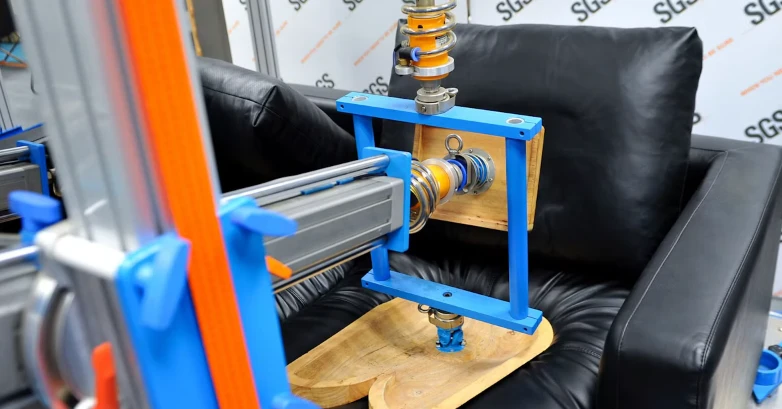
Real photograph of a mechanical furniture testing rig applying controlled loads to an upholstered sofa in an SGS testing laboratory.
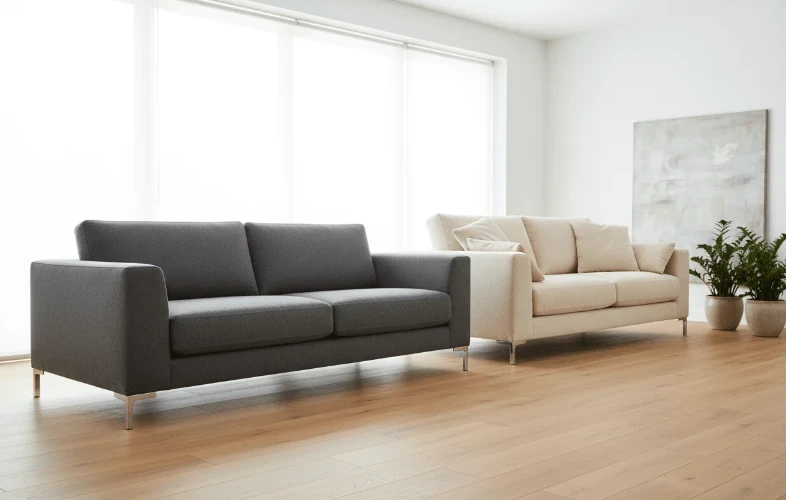
Real photograph comparing a dark gray structured sofa with firm cushions and a light beige sofa with softer, deeper cushions.

Real hotel guest room with a gray upholstered sofa positioned beside the bed and decorative cushions.
Practical QC Checklist to Verify Sofa Comfort Before Mass Production
A successful bulk order requires more than a satisfactory pre-production sample.
The supplier must demonstrate that the approved construction can be reproduced consistently, that the materials match the purchasing specification, and that finished sofas pass the agreed inspection requirements.
The following process can be incorporated into a factory audit and production quality-control plan.
1. Establish a Written Comfort Reference Before Sampling
Before approving a sample, buyers should define what the finished sofa is expected to feel like.
Avoid descriptions such as:
Very comfortable.
Medium soft.
Premium seating.
Luxury cushioning.
Extra supportive.
These descriptions are subjective and can be interpreted differently by different factories.
Instead, create a reference specification covering:
|
Item |
Required reference |
|
Seat foam |
Material type, density and supplier |
|
Seat hardness |
Agreed indentation hardness and test method |
|
Foam thickness |
Approved dimension and tolerance |
|
Cushion layers |
Complete layer arrangement |
|
Fiber wrap |
Material type, weight or thickness where specified |
|
Spring system |
Type, specification and installation layout |
|
Suspension |
Spring or webbing construction |
|
Seat dimensions |
Width, depth and height |
|
Back cushion |
Filling material and construction |
|
Upholstery |
Fabric or leather reference and approved specification |
The approved sample should be photographed and documented.
If possible, retain a reference cushion from the approved sample and identify it with a sample number, date, and material specification.
This creates a physical benchmark for later inspections.
2. Conduct a Commercial Grade Sofa Cushion Durability Test
A commercial grade sofa cushion durability test(插入链接:https://www.jsc-sofa.com/about-us) should evaluate more than the initial firmness of the seat.
The buyer needs to understand how the cushion changes after repeated compression.
At the material level, ISO 3385 provides a constant-load pounding method for evaluating fatigue in flexible cellular materials.
The standard measures changes in thickness and hardness under defined testing conditions.
ISO 2439 provides complementary information about indentation hardness.
ASTM D3574 offers additional foam test methods for polyurethane materials.
These tests can support material selection and incoming quality control. However, they should not be presented as a substitute for complete furniture testing.
For finished commercial seating, the buyer should also consider an appropriate furniture durability standard.
Two useful references are:
ANSI/BIFMA X5.4-2020 (R2025)
This standard covers public and lounge seating commonly used in indoor public environments, including reception, waiting, and gathering areas.
BIFMA reaffirmed the 2020 edition in 2025.
EN 16139:2025
This European standard specifies safety, strength, and durability requirements for non-domestic seating intended for adult users within its stated scope.
An important limitation must be understood: EN 16139:2025 does not itself cover upholstery material durability, electrical safety, or the durability of reclining mechanisms.
Buyers should therefore select additional testing where their products include these features.
For a hotel project, the factory should provide evidence that the test method and severity level are appropriate for the intended application.
A test report should identify:
Product model and configuration.
Test laboratory and report number.
Applicable standard and edition.
Test procedure and loading conditions.
Number of cycles where applicable.
Initial and final measurements.
Any observed structural damage or functional failure.
Final pass/fail assessment against the applicable criteria.
A supplier stating that a sofa has passed a durability test without identifying the model, configuration, and report is not providing sufficient evidence.
3. Check Sample-to-Production Consistency
The approved sample must become the reference for mass production.
This is especially important when the order involves multiple production batches or several containers.
A factory QC team should compare production cushions against the approved sample.
Recommended checks include:
Foam verification
Confirm the foam supplier, material identification, density, and indentation hardness.
Where material batches change, request verification before using the new material in production.
Dimensional verification
Measure cushion length, width, and thickness.
Check that the cushion fits the cover without excessive stretching or loose fabric.
Filling distribution
Inspect fiber wrapping and filling distribution.
Uneven filling can create hard spots, soft corners, and visible surface irregularities.
Suspension verification
Check spring spacing, attachment points, webbing tension, and seat deck alignment.
Seating comparison
Use the same evaluation method for the approved sample and production units.
Avoid relying on one inspector's subjective impression.
A simple comparative evaluation can include sitting for the same duration, using the same posture, and checking the same seat positions.
Where a compression measurement device is available, record the results under controlled conditions.
4. Create a Factory QC Checklist for Seating Consistency
For larger orders, quality inspection should take place at several production stages rather than only at final packing.
The following checklist provides a practical framework.
|
Inspection stage |
QC checkpoint |
Acceptance requirement |
|
Incoming materials |
Foam identification |
Matches approved material specification |
|
Incoming materials |
Foam density and hardness |
Within agreed specification and tolerance |
|
Frame production |
Frame dimensions |
Matches approved drawings |
|
Frame production |
Joints and reinforcement |
Secure, with no visible structural defects |
|
Suspension installation |
Springs and webbing |
Correct layout, attachment and tension |
|
Cushion production |
Foam dimensions |
Within approved tolerances |
|
Cushion production |
Fiber wrapping |
Even coverage and distribution |
|
Upholstery |
Fabric and leather |
Correct approved material and color |
|
Assembly |
Cushion fit |
No excessive gaps or forced fitting |
|
Finished product |
Seat dimensions |
Matches approved reference |
|
Finished product |
Comfort comparison |
No unexplained difference from approved sample |
|
Final inspection |
Structural and visual condition |
Meets agreed acceptance criteria |
|
Packing |
Cushion protection |
No harmful compression or deformation during packing |
This checklist should be adapted to the product design and purchase order.
For example, a reclining sofa requires additional checks for mechanism operation and electrical components. A sofa bed requires inspection of its opening and closing mechanism, support structure, and mattress assembly.
If the order includes functional seating, the buyer should review the relevant product-specific requirements rather than relying exclusively on a general seating durability standard.
5. Apply a Consistent Seating Evaluation Procedure
A practical factory audit should use a repeatable evaluation procedure.
The following approach can be used for pre-production approval and random production inspections.
Step 1: Prepare the reference sofa
Place the approved sample on a level floor under consistent environmental conditions.
Record its dimensions and cushion configuration.
Step 2: Inspect each seating position
For a multi-seat sofa, evaluate the left, center, and right seating positions separately.
This helps identify differences caused by foam cutting, suspension installation, or assembly.
Step 3: Evaluate the initial sitting experience
Check whether the seat feels excessively hard, excessively soft, or uneven.
Pay attention to the transition between the upper comfort layer and the underlying support layer.
Step 4: Evaluate back support
Check whether the back cushion provides suitable support without forcing the user into an uncomfortable position.
Step 5: Check recovery
After the agreed compression procedure, observe whether the cushion returns to its expected profile.
Visible deformation, uneven recovery, and permanent impressions should be investigated.
Step 6: Compare with the reference sample
Repeat the same procedure on selected production units.
Record any differences and investigate their causes before releasing the batch.
A useful improvement is to assign identification numbers to inspected products.
For example, a buyer may inspect units from the beginning, middle, and end of production rather than selecting all samples from one completed production section.
This helps identify variation that may develop over time.
6. Control Material Changes During Mass Production
Material substitution is one of the most important issues in bulk furniture purchasing.
A supplier may change foam, fabric, springs, or fiber filling because of availability, pricing, or production scheduling.
Even when the replacement material appears similar, it may affect the finished product's comfort and durability.
The purchase agreement should clearly state that changes to the following items require buyer approval:
Foam supplier or foam formulation.
Foam density and indentation hardness.
Cushion layer construction.
Spring type and specification.
Fiber filling material.
Suspension construction.
Upholstery material.
Cushion dimensions.
The factory should maintain material batch records so that production units can be traced to their incoming materials.
This is particularly valuable when an importer receives complaints from multiple retailers or hospitality locations.
Without batch traceability, it becomes difficult to determine whether a problem originated from one material shipment, one production line, or an entire order.
7. Verify Packing and Container Handling
Comfort-related quality issues can also occur during shipping.
Vacuum compression and space-saving packaging may be suitable for certain sofa designs, but the packaging process must be validated for the actual foam and cushion construction.
Excessive compression, inappropriate storage duration, and insufficient recovery time can affect the finished cushion's appearance and dimensions.
For wholesale orders, buyers should confirm:
Whether cushions are compressed during packing.
The maximum approved compression level.
The permitted packing duration.
Recovery time after unpacking.
Whether cushions require manual reshaping.
Whether the factory has completed packaging validation.
Whether the inspection procedure includes unpacked samples.
A practical approach is to unpack selected cartons during the pre-shipment inspection and observe the cushions after the agreed recovery period.
This is especially important when the supplier uses compressed packaging to improve container loading efficiency.
The buyer should not assume that a sofa's appearance immediately after unpacking represents its final recovered condition.
8. Reduce Return Risk Through Production Documentation
For buyers sourcing comfortable sofas with low return risk, documentation is just as important as physical inspection.
A reliable supplier should be able to provide a complete record of the approved product configuration.
The documentation package should include:
1. Approved product drawings and dimensions.
2. Cushion construction specification.
3. Foam technical data and relevant test reports.
4. Spring and suspension specifications.
5. Upholstery material information.
6. Approved pre-production sample photographs.
7. Incoming material inspection records.
8. In-process QC inspection records.
9. Finished product inspection reports.
10. Packaging and recovery instructions.
For larger wholesale orders, it is also useful to retain a golden sample or an approved reference cushion.
The golden sample should be clearly identified and protected from unauthorized modification.
When a production problem occurs, both parties can compare the affected units against the same reference.
This makes discussions more objective and helps prevent disagreements based on different interpretations of comfort.
9. A Practical Pre-Production Approval Workflow
A structured workflow reduces the likelihood of discovering a major comfort problem after production has started.
|
Stage |
Buyer action |
Factory responsibility |
|
Product selection |
Define application and comfort expectations |
Recommend suitable construction |
|
Technical confirmation |
Review foam and suspension specifications |
Provide material details |
|
Sample development |
Evaluate physical comfort and dimensions |
Produce reference sample |
|
Sample approval |
Sign off on the final configuration |
Freeze approved specifications |
|
Pre-production |
Confirm material availability |
Verify incoming materials |
|
Mass production |
Review inspection records |
Maintain approved construction |
|
Pre-shipment inspection |
Compare selected units against sample |
Complete final QC |
|
Post-arrival review |
Check unpacking and recovery |
Support investigation of any issues |
For retail buyers, this process can be applied to individual product models.
For hospitality projects, it should be applied to each seating configuration and upholstery specification.
For multi-container orders, production records should also identify which material batches and production periods correspond to each shipment.
10. Use Product-Specific Checks for Functional Sofa Categories
Not all upholstered seating follows the same inspection procedure.
Some products require additional mechanical checks.
For example, an electric recliner sofa requires evaluation of motor operation, repeated reclining cycles, wiring protection, and mechanism alignment.
A hide-a-bed sofa needs additional checks covering opening and closing performance, mattress support, folding joints, and the seating surface when the bed mechanism is stored.
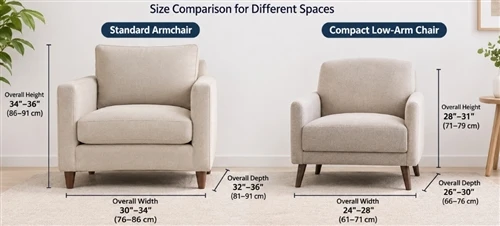
A low armchair may require closer attention to seat height, armrest position, and the relationship between seat depth and back support.
These examples highlight an important point: a general sofa comfort checklist is a starting point, not a replacement for product-specific engineering and quality testing.
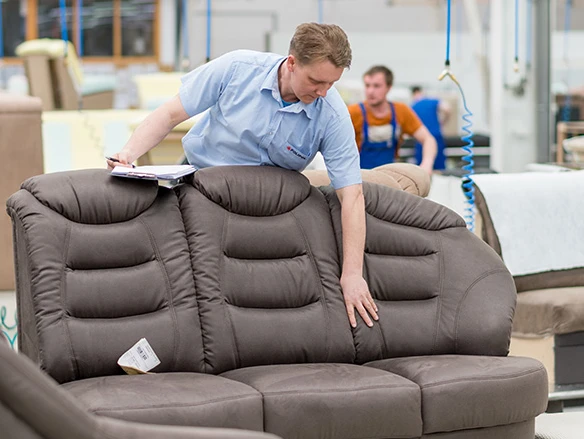
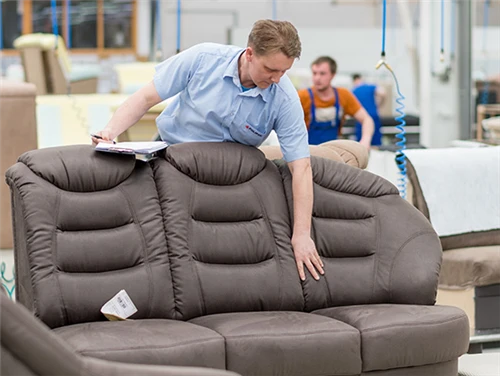
Real photograph of a factory quality inspector examining a brown upholstered sofa cushion and backrest during production.
Conclusion: Consistency Matters More Than a Brand Name
For furniture wholesalers, importers, and hospitality procurement teams, choosing a comfortable sofa is not simply a matter of selecting a recognizable manufacturer.
A product that feels excellent in a showroom may perform differently after months of repeated commercial use. Foam density, indentation hardness, spring construction, suspension, seat geometry, and upholstery all influence the final seating experience.
The most reliable purchasing strategy is to replace subjective comfort descriptions with measurable product specifications and repeatable quality-control procedures.
Before placing a bulk order, buyers should focus on five priorities:
- Define the application. Residential retail, hotel lounges, and commercial waiting areas require different seating characteristics.
- Specify the complete cushion system. Foam density, indentation hardness, thickness, fiber wrapping, and suspension must be considered together.
- Verify durability. Use relevant foam and finished-furniture testing methods to evaluate performance under defined conditions.
- Control mass production. Compare production units with an approved reference sample and prevent unauthorized material substitutions.
- Maintain traceability. Keep material records, inspection reports, and packing validation documents for every major production batch.
Ultimately, the objective is not to find a single brand that claims to offer the best comfort. It is to establish a product specification and manufacturing process that consistently deliver the intended seating experience.
For professional buyers, consistent quality across every shipment is far more valuable than an impressive first impression from one showroom sample.
Sources
The following standards and technical references support the material-testing, durability, and quality-control recommendations in this article.
1. ASTM International - ASTM D3574-25
Standard Test Methods for Flexible Cellular Materials-Slab, Bonded, and Molded Polyurethane Foams.
Provides standardized test methods for evaluating flexible polyurethane foam. ASTM identifies applications including research, quality control, and acceptance or rejection under defined specifications.
https://store.astm.org/standards/d3574
2. International Organization for Standardization - ISO 3385:2014
Flexible cellular polymeric materials - Determination of fatigue by constant-load pounding.
Evaluates changes in thickness and hardness after repeated loading. The standard is relevant to flexible foam used in load-bearing upholstery applications. ISO confirmed this edition as current in 2025.
https://www.iso.org/standard/55743.html
3. International Organization for Standardization - ISO 2439:2008
Flexible cellular polymeric materials - Determination of hardness (indentation technique).
Provides methods for measuring indentation hardness and related load-bearing characteristics of flexible cellular materials.
https://www.iso.org/standard/42717.html
4. Business and Institutional Furniture Manufacturers Association - ANSI/BIFMA X5.4-2020 (R2025)
Public and Lounge Seating.
Covers safety, durability, and structural adequacy testing for public and lounge seating used in indoor commercial environments. The 2020 edition was reaffirmed in 2025.
https://www.bifma.org/page/standardsshortdesc
5. British Standards Institution - BS EN 16139:2025
Furniture - Safety, strength and durability - Requirements and test methods for non-domestic seating.
Provides requirements and testing methods for non-domestic seating within its stated scope. Buyers should note that this standard does not cover upholstery material durability, electrical safety, or reclining mechanism durability.
6. International Organization for Standardization - ISO 12947-2:2016
Textiles - Determination of the abrasion resistance of fabrics by the Martindale method - Part 2: Determination of specimen breakdown.
Provides a standardized procedure for determining textile specimen breakdown under Martindale abrasion testing. The standard does not apply to coated fabrics.
https://www.iso.org/standard/61058.html
7. Polyurethane Foam Association - Flexible Polyurethane Foam Applications
Provides technical background on the use of flexible polyurethane foam in upholstered furniture, including seat cushions, arms, back cushions, and foam wrapping.
https://pfa.org/furniture-case-study/
8. BIFMA - Standards Descriptions
Provides an overview of the scope and application of BIFMA furniture performance standards, including public and lounge seating.
https://www.bifma.org/page/standardsshortdesc
9. A2LA - BIFMA Compliant Accreditation Program
Explains the relationship between furniture testing, ISO/IEC 17025-accredited laboratories, and the BIFMA Compliant program.